

Key Takeaways
Native Plants
Native plants are species that naturally evolved in a specific region over thousands of years without human introduction. Because they developed alongside local soils, climate patterns, insects, and wildlife, they are naturally adapted to thrive in those conditions. In a residential landscape, native plants often require less supplemental watering, fewer fertilizers, and minimal pesticide applications compared to non-native species.
Plant nativity is region-specific: a species native to the Pacific Northwest may be considered non-native - or even invasive - in the Southeast. Always verify regional nativity using resources like your state's native plant society or the USDA PLANTS Database.
Why the Traditional Lawn Is Being Reconsidered
For decades, the image of a healthy American yard meant a carpet of uniform, green turf - trimmed weekly, watered regularly, and fertilized on schedule. That model has worked, but it comes with real costs: high water consumption, chemical inputs, and limited ecological value. Across the country, homeowners are beginning to ask whether there's a better approach.
Native plants offer a compelling alternative - or at least a meaningful supplement. Because they evolved in local conditions, they tend to work with your landscape rather than against it. That doesn't mean they're maintenance-free, but the trade-offs are often favorable. If you've ever struggled with thinning or patchy turf, native groundcovers or wildflower patches in those problem areas can be a practical fix rather than a constant battle.
~40 million
Acres of lawn in the contiguous United States
According to NASA-funded research, turfgrass covers an estimated 40 million acres in the contiguous U.S., making it one of the most irrigated crops in the country.
30-60%
Share of residential water use going to landscaping
The U.S. Environmental Protection Agency estimates that landscape irrigation accounts for roughly 30 to 60 percent of residential water use, depending on region and season.
4,000+
Native bee species in North America
The USDA notes that North America hosts more than 4,000 native bee species, many of which depend on native flowering plants for food and nesting resources.
What Makes a Plant Truly Native?
The term "native" is more specific than it might seem. A plant is considered native to a region if it occurred there naturally - without human introduction - before European settlement. That distinction matters because nativity is not national; it's regional. Echinacea purpurea (purple coneflower), for example, is native to the central and eastern United States but not to the West Coast.
This regional specificity is why finding the right plants for your yard requires a bit of local research. Your state's cooperative extension service or native plant society can point you toward species well-suited to your county or ecoregion. Understanding your soil pH and its effect on plant health is also valuable groundwork before selecting species, since even native plants perform best when soil chemistry is in a suitable range.
Invasive vs. Native: An Important Distinction
Some plants sold as "wildflowers" or "naturalized" species are actually invasive non-natives that can crowd out true native flora. English ivy, Japanese honeysuckle, and autumn olive are well-known examples. When sourcing plants, confirm species with your local extension office or a native plant nursery rather than relying solely on garden center labeling.
Ecological and Practical Benefits for Homeowners
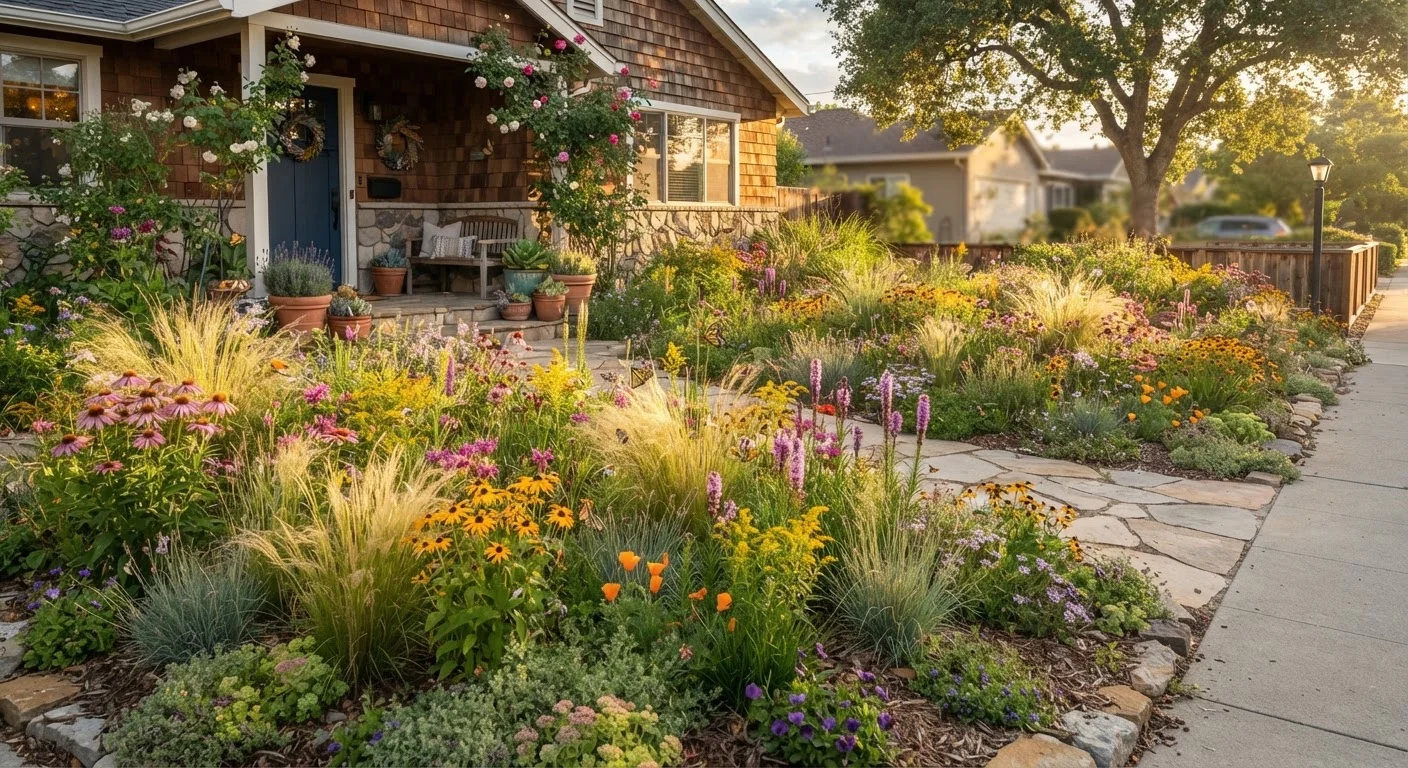
Native plants support local ecosystems in ways that non-native species typically cannot. Many native bees, butterflies, and other pollinators have co-evolved with specific regional plants - they rely on them for nectar, pollen, and larval habitat. Turf grass and ornamental non-natives rarely provide that same support.
From a practical standpoint, established native plantings generally need less supplemental irrigation than turf or exotic ornamentals - making them a natural companion to drought-tolerant landscaping strategies. Deep root systems also improve soil drainage and reduce runoff, which matters especially on slopes or clay-heavy lots.
Native plants also tend to pair well with other ecological gardening approaches. If you're exploring companion planting, many native species attract the beneficial insects that make those plant partnerships work more effectively.
“A yard managed for biodiversity - with native plants, reduced mowing, and fewer chemicals - can provide meaningful habitat even in dense suburban neighborhoods. Small parcels add up across a landscape.”
— Doug Tallamy, Entomologist and author, University of Delaware
How to Start Incorporating Native Plants Into Your Yard
Transitioning to a native-friendly yard doesn't require tearing everything out. A measured, zone-by-zone approach works well for most homeowners.
- Identify underperforming areas first. Shaded zones, slopes, or spots where grass consistently struggles are ideal candidates for native groundcovers or wildflower patches.
- Research your plant palette. Use your state's native plant society, USDA PLANTS Database, or local extension office to build a list of regionally appropriate species.
- Consider bloom times and heights. A layered planting - low groundcovers, mid-height perennials, and taller grasses or shrubs - creates visual interest and supports a broader range of wildlife.
- Prepare your soil. Even native plants benefit from good soil preparation. Amending compacted or degraded soil before planting gives roots room to establish.
- Mulch around new plantings. Mulch suppresses weeds and retains moisture during the critical establishment period. See the trade-offs between mulching and bare soil for guidance on which approach fits your situation.
- Plan for seasonality. If you're planting in fall, native perennials can establish root systems over winter for a stronger spring emergence - something worth incorporating into your fall lawn prep checklist.
Start Small With a Pollinator Patch
If a full landscape conversion feels overwhelming, begin with a dedicated pollinator patch - a 4-by-8-foot bed of native flowering plants in a sunny spot. This small footprint introduces native species with minimal disruption and gives you a chance to observe how they perform in your specific yard conditions before expanding. Many gardeners find it a satisfying proof of concept.
Setting Realistic Expectations
Native plants are not a zero-effort solution. The establishment phase - typically the first full growing season - still requires attentive watering and occasional weeding. Results also vary by species, site conditions, and climate. Some plants establish quickly; others take two to three seasons to fill in and bloom reliably.
Design also plays a larger role than many homeowners anticipate. A yard full of natives can look lush and intentional, or it can look unkempt - the difference is largely in how plantings are arranged and edged. If your neighborhood has a homeowners association, checking any relevant landscaping rules before making major changes is a worthwhile step.
Whether you swap out a single border or gradually reduce your turf footprint over several seasons, incorporating native plants is a shift in how you think about what a yard is for - not just a surface to maintain, but a functioning piece of the local landscape.