

Key Takeaways
Why Plant Pairings Matter
Companion planting is the practice of growing two or more plant species near each other for mutual benefit - whether that's deterring insects, improving nutrient availability, or making smarter use of vertical and horizontal space. Gardeners have refined these combinations over generations, and while not every pairing is backed by controlled research, many have proven consistently useful in home garden settings.
It's worth noting that companion planting is not a guaranteed fix for pest or yield problems. Think of it as one layer in a broader garden strategy - alongside soil preparation, watering practices, and good plant selection. For context on how your soil environment affects these dynamics, our guide on mulching versus bare soil covers how ground cover choices influence moisture, weeds, and root health.
Below are seven plant pairings that consistently appear in experienced gardeners' go-to lists - along with the reasoning behind why each one tends to work.
Tomatoes and Basil
This is perhaps the most popular companion pairing in the home vegetable garden. Gardeners widely report that basil planted near tomatoes helps deter aphids, whiteflies, and tomato hornworm - though the scientific evidence is mixed and results vary by garden. What's more consistently observed is that basil thrives in the same warm, well-drained conditions tomatoes prefer, making them naturally compatible neighbors from a growing standpoint.
Keep basil from being fully shaded by sprawling tomato foliage by planting it along the sunnier edge of the bed. Many gardeners also find the proximity convenient for harvesting both at once.
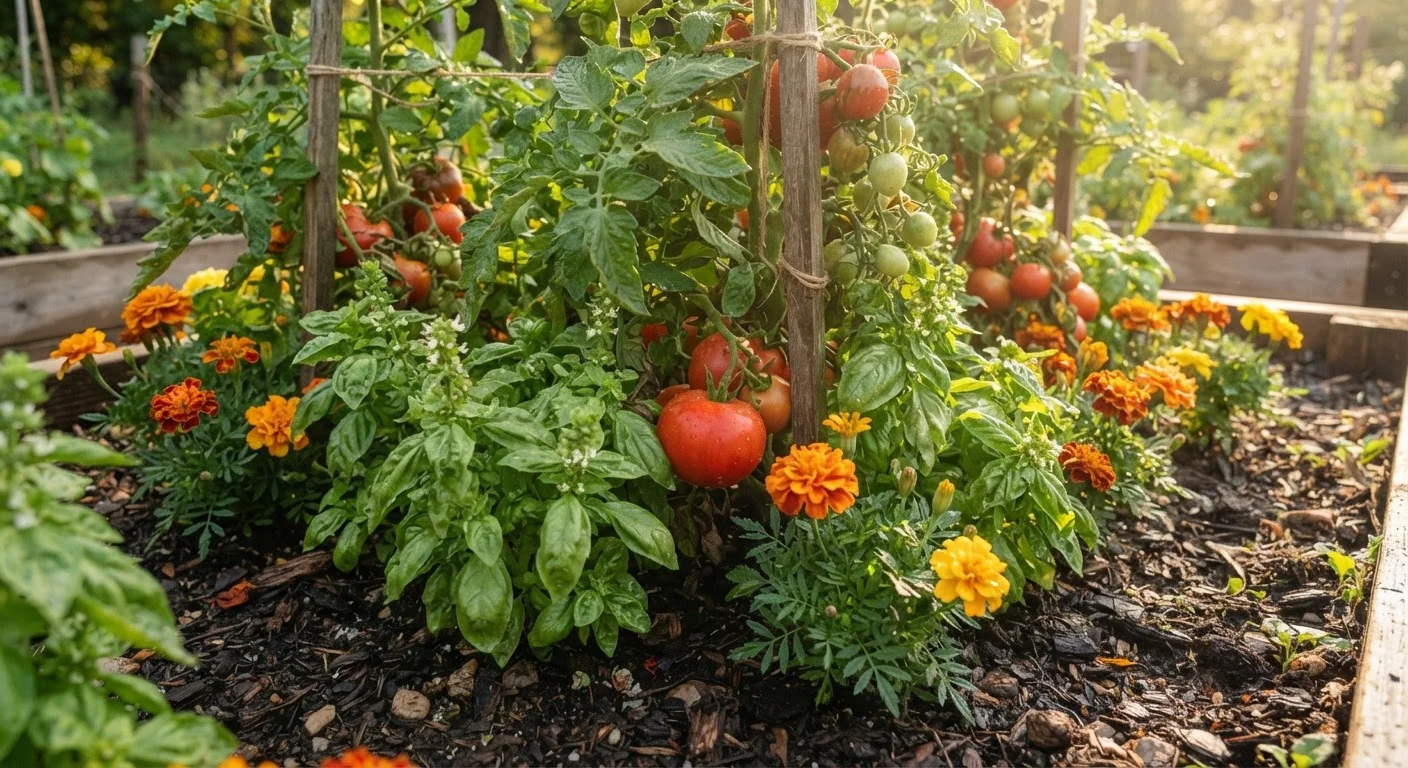
Basil and tomatoes share growing conditions and may help deter common tomato pests.
The Three Sisters: Corn, Beans, and Squash
This triad has been used by Indigenous agricultural communities in North America for centuries and remains one of the most structurally elegant companion systems available to home gardeners. Corn provides a vertical support for pole beans to climb. Beans fix atmospheric nitrogen into the soil, benefiting all three plants. Squash spreads along the ground, shading the soil to retain moisture and suppress weeds.
Each plant fills a distinct ecological niche - vertical, nitrogen, and ground cover - making this combination an efficient use of a single bed. It works best in larger garden spaces where corn can reach full height without shading out neighboring crops.
The Three Sisters system turns three plants into a self-supporting, soil-enriching ecosystem.
Carrots and Onions
The logic behind this pairing centers on scent masking. Onions produce a strong sulfur-based aroma that may confuse or repel carrot flies, while carrots are thought to deter onion flies in return. The combination is a classic example of mutual pest disruption through aromatic interference.
Both crops are relatively compact root vegetables that don't compete aggressively for canopy space, which makes them practical neighbors in tighter raised-bed setups. Interplanting them in alternating rows is a common approach.
Onions and carrots may deter each other's primary insect pests through strong aromatic signals.
Marigolds and Almost Everything
French marigolds (Tagetes patula) are frequently described as the universal companion plant. Their roots produce a compound called alpha-terthienyl that research has shown can suppress certain soil nematodes - microscopic pests that damage root systems. Above ground, their scent is said to deter aphids and whiteflies, though results vary.
Marigolds are easy to grow, bloom prolifically, and attract pollinators - making them a low-risk addition to nearly any vegetable or flower bed. Plant them as a border or intersperse them throughout the garden for broad coverage.
Marigold roots produce compounds that can suppress harmful soil nematodes in vegetable beds.
Cucumbers and Nasturtiums
Nasturtiums are often used as a trap crop - meaning they attract aphids away from more valuable plants like cucumbers. Rather than repelling pests, this strategy redirects them. Aphids tend to colonize nasturtiums heavily, concentrating the problem in one area where it can be managed or tolerated.
Nasturtiums also produce edible flowers and leaves, so they pull double duty as both a garden tool and a culinary plant. They grow quickly from seed and thrive in similar conditions to cucumbers - warm soil and full sun.
Nasturtiums act as a trap crop, drawing aphids away from cucumber plants and concentrating them.
Peppers and Pigweed (Amaranth)
This is a lesser-known pairing that experienced vegetable gardeners sometimes use intentionally. Allowing amaranth - often considered a weed - to grow near pepper plants can attract predatory insects that feed on pepper pests like aphids and stink bugs. Amaranth also has deep taproots that help break up compacted soil layers, potentially improving drainage and aeration around shallower-rooted peppers.
This pairing requires some management to prevent amaranth from going to seed and spreading, but controlled growth near peppers can offer measurable pest management support without added chemical inputs.
Controlled amaranth near peppers attracts beneficial predatory insects and improves soil structure.
Lettuce and Tall Brassicas
Lettuce is a cool-season crop that bolts (goes to seed prematurely) when exposed to intense summer heat. Planting it beneath taller brassicas like kale, Brussels sprouts, or broccoli provides natural shade that extends the lettuce harvest into warmer weeks. This is a spatial efficiency strategy as much as a traditional companion pairing.
The arrangement works best when the taller plants are established first and lettuce is tucked into the filtered-light zone beneath them. It's particularly effective in raised bed gardens where spacing can be precisely controlled.
Tall brassicas cast natural shade that keeps lettuce cool and extends the harvest window.
Getting the Most from Your Plant Pairings
Even the most reliable companion combinations won't perform well if the fundamentals are off. Before pairing plants, confirm they share compatible light and water requirements. A moisture-loving plant paired with a drought-tolerant one creates a watering conflict that no amount of plant chemistry can resolve.
Start Small and Observe
If you're new to companion planting, choose one or two pairings to trial in the current season rather than reorganizing your entire garden at once. Keep a simple journal noting what you planted together, any pest activity you observed, and how each pairing performed. Real-world results in your specific soil and microclimate are the most reliable guide you'll have for planning future seasons.
It's also smart to keep records. Note which pairings thrived in your specific soil and climate, since regional conditions vary widely. What works well in a humid Southern garden may behave differently in an arid Western yard. Some widely repeated companion planting claims have also been questioned - our article on garden myths that could be hurting your plants explores beliefs that don't always hold up under scrutiny.
For gardeners interested in building soil fertility to support all these combinations, pairing companion planting with a home composting system can make a meaningful difference. See our primer on composting at home for a practical starting point. Whether you're working with raised beds or in-ground rows, thoughtful plant pairings remain one of the most low-cost, low-effort tools available to home gardeners.