

Key Takeaways
What Is Lawn Aeration?
Lawn aeration is the process of creating small openings in your soil to reduce compaction and restore airflow, water movement, and nutrient exchange to grass roots. The most effective form - core aeration (also called plug aeration) - uses a machine to extract small cylinders of soil, leaving channels roughly 2-4 inches deep throughout the lawn.
A less effective alternative is spike aeration, which punctures the soil with solid tines rather than removing material. Because it displaces soil rather than extracting it, spike aeration can sometimes worsen compaction around each hole. For most lawns, core aeration is the clear choice.
Aeration addresses one of the most common and overlooked causes of lawn decline: soil that has become so dense that grass struggles to survive, even with regular watering and fertilizing.
Not Sure If You Need to Aerate?
Try the screwdriver test: push a standard screwdriver into your lawn with hand pressure only. If it doesn't sink at least 2 inches easily, your soil is likely compacted enough to benefit from aeration. Do this test after a rain or normal watering for the most accurate read.
Why Compacted Soil Hurts Your Lawn
Soil compaction occurs gradually when foot traffic, heavy equipment, or repeated mowing presses soil particles tightly together. Clay-heavy soils are especially prone to compaction, though any lawn subjected to consistent use can develop the problem over time.
When soil becomes too compact, three critical things happen:
- Air is squeezed out - Grass roots, like all living tissue, need oxygen. Dense soil suffocates them.
- Water pools or runs off - Rather than soaking in and reaching the root zone, water stays on the surface or drains away, meaning even a good watering schedule won't deliver results.
- Nutrients can't penetrate - Fertilizers sit near the surface rather than reaching roots, making applications less effective. Understanding N-P-K ratios matters little if your soil can't absorb them.
Signs your lawn may need aeration include water pooling after rain, thin or patchy grass in high-traffic areas, a spongy feel underfoot from excess thatch buildup, and difficulty pushing a screwdriver more than 2 inches into the soil.
½ inch
Thatch thickness that signals aeration need
Lawn care extension services widely cite thatch buildup exceeding ½ inch as a key indicator that core aeration is overdue.
2-4 inches
Depth of core aeration channels
University cooperative extension programs recommend tines that penetrate 2-4 inches for effective decompaction in typical residential soils.
1-2x per year
Recommended aeration frequency for most lawns
Most turf management guidelines suggest annual aeration for average lawns, with twice-yearly aeration for heavy clay or high-traffic areas.
When to Aerate: Timing by Grass Type
Timing is critical. The goal is to aerate when your grass is actively growing so it can recover and fill the holes quickly. Aerating at the wrong time stresses grass and slows recovery.
Cool-Season Grasses
Grasses like Kentucky bluegrass, tall fescue, and ryegrass grow most vigorously in the cooler temperatures of spring and fall. Early fall - typically late August through October depending on your region - is the optimal window. The soil is still warm, growth is strong, and cooler air limits weed pressure. Fall aeration pairs naturally with overseeding and end-of-season lawn prep.
Warm-Season Grasses
Bermuda, zoysia, St. Augustine, and centipede grasses peak in late spring and summer. Aerate these lawns in late spring, once active growth is underway and overnight temperatures are consistently above 60°F. Aerating too early in spring, before grass breaks dormancy, can invite weed colonization in the open holes. See our guide on cool- vs. warm-season grasses if you're unsure which type covers your yard.
Aerate when the soil is lightly moist - roughly 24-48 hours after a moderate watering. Tines penetrate 30-50% deeper in moist soil than in dry, dramatically improving results.
Depth of penetration is what determines how effectively aeration breaks up compaction and opens channels for root growth; dry soil severely limits how far tines can reach.
For lawns with severe thatch (more than ½ inch), consider dethatching before aerating so tines reach the soil rather than bouncing off the organic layer.
A dense thatch layer acts as a physical barrier; aerating through thick thatch reduces penetration depth and limits the benefits of the process.
How to Aerate: Tools and Technique
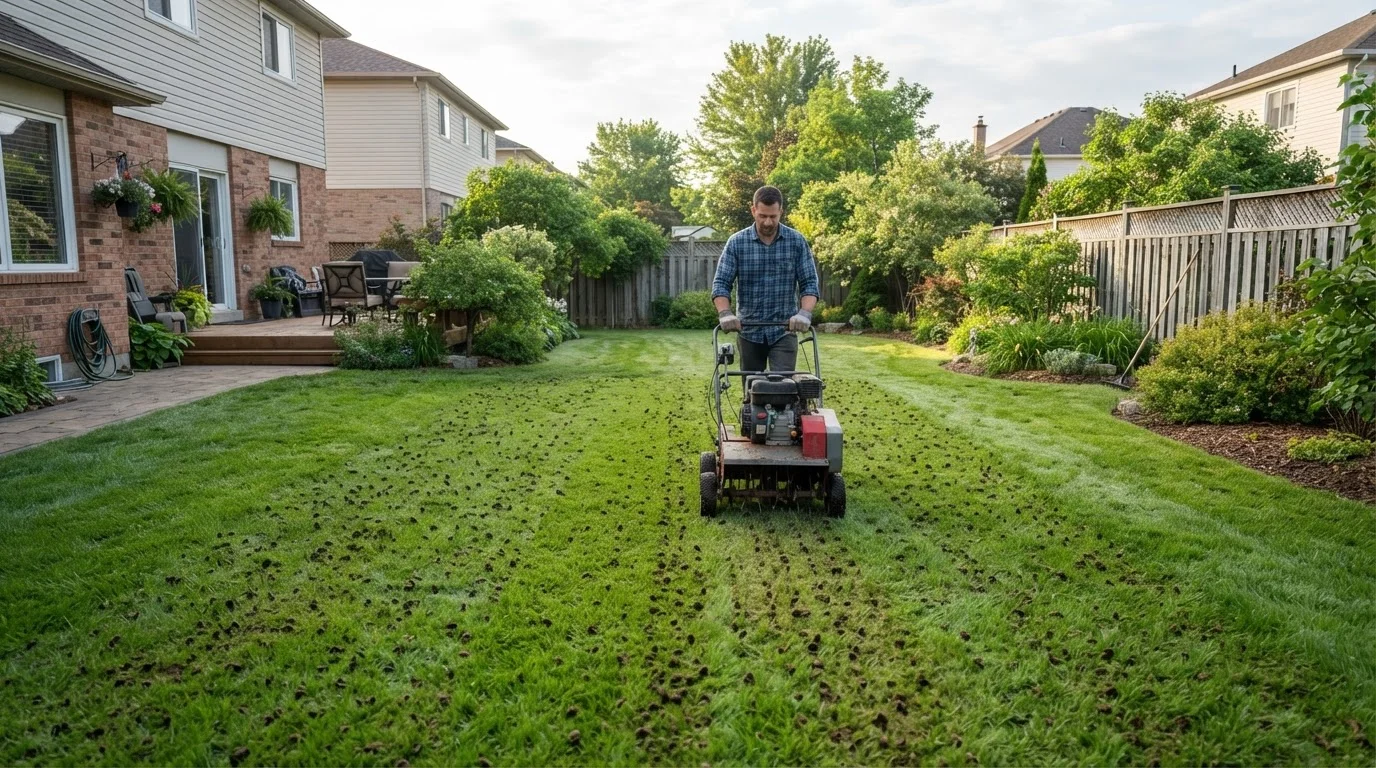
For most residential lawns, a walk-behind core aerator is the tool of the job. These machines are widely available at equipment rental centers and are manageable for most homeowners. Larger riding aerators exist for expansive properties. Hand aerators (manual coring tools) work for very small areas or spot treatments.
Step-by-Step Process
- Water the lawn one to two days before aerating. Moist - not saturated - soil allows tines to penetrate more deeply. Avoid aerating waterlogged or bone-dry ground.
- Mark any hidden hazards. Flag irrigation heads, shallow utility lines, or decorative edging before running the machine.
- Make two passes in perpendicular directions. Crossing your passes (north-south, then east-west) ensures thorough coverage and more even decompaction.
- Leave the soil plugs on the surface. These cores break down within two to four weeks, returning organic matter and microbes to the lawn. Do not rake them up.
- Focus extra passes on high-traffic zones. Areas near gates, playground equipment, or frequent foot paths benefit from additional coverage.
Call Before You Aerate
Before running any powered equipment across your yard, contact your local utility locating service (call 811 in the United States) to have underground lines marked. Irrigation heads, invisible fence wiring, and shallow gas or electric lines can all be damaged by aerator tines. This step is free and takes only a few days.
Aftercare: Making the Most of Aeration
Aeration creates an immediate opportunity for improvement - but only if you follow through with the right aftercare. The open channels in your soil are primed to receive everything your lawn needs.
Overseed
Scatter grass seed immediately after aerating. Seeds will fall into the holes, maintain good soil contact, and germinate far more reliably than on a compacted surface. Match your seed variety to your existing grass type.
Fertilize
Apply a starter or balanced fertilizer right after overseeding. Nutrients will travel directly into the root zone through the aeration channels rather than sitting on the surface. Understanding soil pH before fertilizing helps you choose a product your soil can actually use.
Water Consistently
Keep the soil lightly moist for the first two weeks to support seed germination. After that, transition to deeper, less frequent watering to encourage deep root growth. Avoid heavy irrigation that washes seeds out of the holes.
Hold Off on Foot Traffic
Give your lawn two to four weeks of minimal traffic to allow plugs to break down and new seed to establish. Mow only once new growth reaches the appropriate height for your grass type.
“Aeration is one of the most important cultural practices available for your lawn. Soils become compacted over time and this reduces the ability of air, water, and nutrients to move through the soil profile.”
— Cooperative Extension Turf Specialists, University Extension Turfgrass Program (general consensus position)
Most lawns benefit from aeration once per year. Clay-heavy soils or high-traffic areas may warrant a second aeration session annually. Sandy soils, by contrast, rarely need aeration more than every two to three years.
Cooperative Extension Lawn Care Guides
State land-grant university extension programs publish free, regionally specific lawn aeration and soil management guides tailored to local climate and grass types. Search for your state's extension service online.
811 - Call Before You Dig
The national utility-line locating service for the U.S. Call or submit a request online before any outdoor equipment work to have underground utilities marked at no cost.
Soil Test Kit or Lab Service
A basic soil test reveals pH and nutrient levels so you can target fertilization after aeration more precisely. Many cooperative extension offices offer low-cost soil testing.