

Key Takeaways
Option A
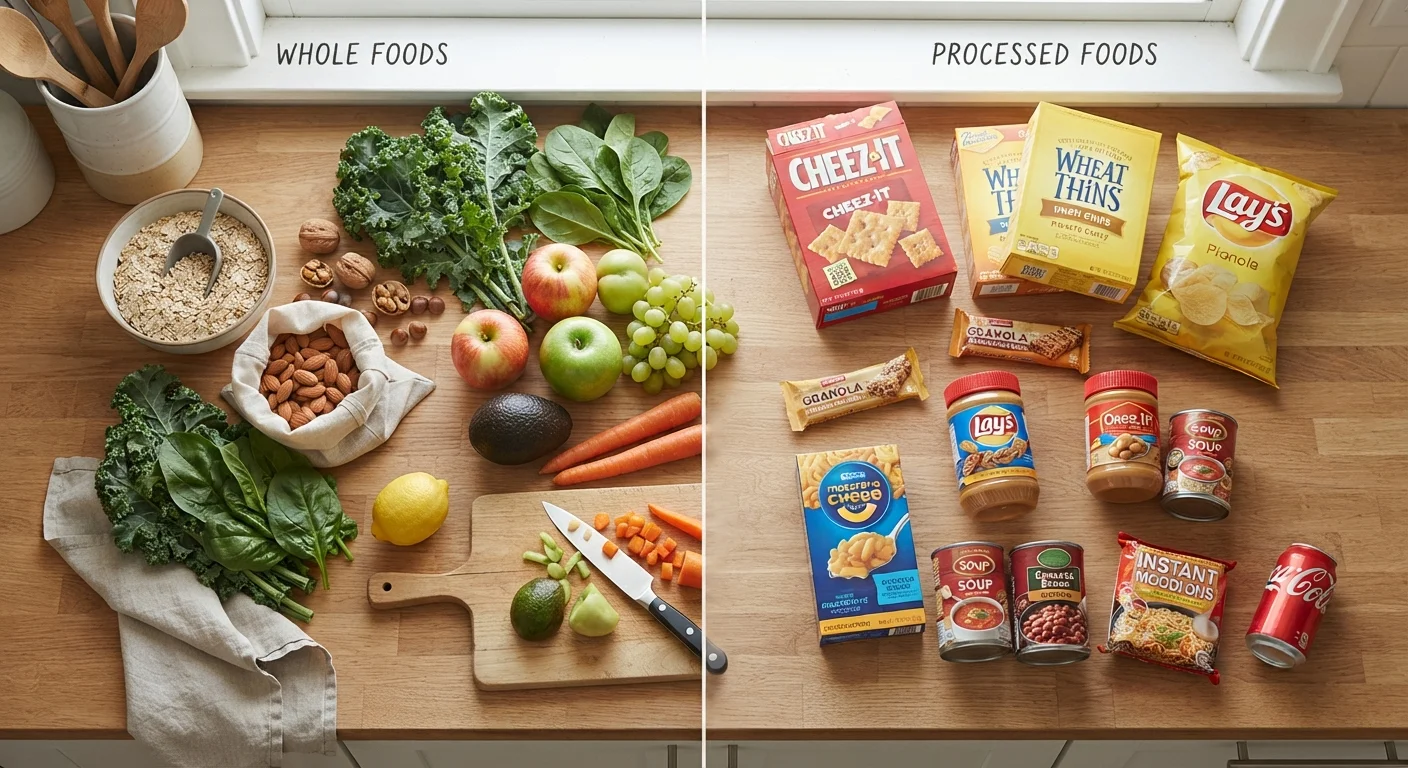
Whole Foods
Foods in or close to their natural, unaltered state.
Best for: People looking to anchor their diet in nutrient-dense, minimally altered ingredients with fewer additives.
Option B
Processed Foods
A broad spectrum from lightly prepared to heavily reformulated products.
Best for: Understanding where common everyday foods fall on the processing scale - and which trade-offs actually matter.
If you want to build a nutrient-dense everyday diet
Whole Foods
Whole and minimally processed foods tend to deliver more fiber, vitamins, and minerals with fewer added sugars, sodium, and synthetic additives. Making them the foundation of most meals aligns with mainstream dietary guidance.
If convenience, cost, or access are real constraints
Processed Foods
Many moderately processed foods - canned beans, frozen vegetables, whole-grain bread - are affordable, shelf-stable, and nutritionally sound. Dismissing all processed food ignores the practical realities most households face.
If you want to reduce ultra-processed food intake specifically
Whole Foods
Swapping ultra-processed items for whole or minimally processed alternatives is the most evidence-supported dietary shift, according to public health nutrition research.
If you are evaluating packaged foods at the grocery store
Processed Foods
Not all packaged foods are ultra-processed. Using the NOVA framework and checking the ingredients list helps identify which processed options are reasonable choices.
Why 'Processed' Doesn't Mean What Most People Think
Ask most people what a processed food is, and they'll picture a bag of chips or a fast-food meal. That intuition captures something real - but it misses a much bigger picture. Technically, any food that has been altered from its raw state is processed. That includes frozen spinach, pasteurized milk, canned tomatoes, and rolled oats. Calling all of these equally problematic would make navigating the grocery store nearly impossible.
The more useful question isn't whether a food has been processed, but how much and to what end. Processing for preservation - freezing, drying, fermenting - is fundamentally different from processing that adds colorings, emulsifiers, flavor enhancers, and synthetic sweeteners to reconstruct something that barely resembles a whole ingredient. Understanding that distinction is where clarity begins.
For a deeper look at how food science and nutrition research interact, see why nutrition science gets complicated.
The NOVA Classification System Explained
Developed by researchers at the University of São Paulo, the NOVA classification system organizes foods into four groups based on the extent and purpose of industrial processing - not nutrient content alone.
| Criterion | Whole / Minimally Processed | Ultra-Processed |
|---|---|---|
| NOVA Group | Groups 1-2 | Group 4 |
| Typical ingredients | Single or few, recognizable | Many, including additives |
| Fiber content | Generally higher | Often stripped out |
| Added sugars / sodium | Naturally low or absent | Often high |
| Shelf stability | Variable; often lower | Engineered for long shelf life |
| Cost | Variable; staples are affordable | Often inexpensive per serving |
| Research associations | Linked to better diet quality | Linked to poorer diet quality |
Group 1 (Unprocessed or minimally processed) includes fresh fruits, vegetables, plain meats, eggs, and legumes - foods consumed in their natural form or with only minor physical alterations like freezing or drying.
Group 2 (Processed culinary ingredients) covers substances extracted from Group 1 foods - think flour, oil, butter, or sugar - used primarily in cooking rather than eaten alone.
Group 3 (Processed foods) are products made by combining Group 1 and Group 2 items, often with preservation in mind: canned fish, cheese, cured meats, or simple whole-grain breads. These have limited added ingredients and are recognizable as food.
Group 4 (Ultra-processed foods) are industrially formulated products that contain ingredients rarely found in a home kitchen - hydrogenated oils, protein isolates, high-fructose corn syrup, artificial flavors, and emulsifiers. Packaged snacks, sugary breakfast cereals, flavored instant noodles, and many fast-food items fall here.
NOVA is a research tool, not a government standard, so it won't appear on food labels. But understanding its logic helps reframe how you evaluate what you're eating.
57%
Share of U.S. calories from ultra-processed foods
A study published in BMJ Open estimated that ultra-processed foods accounted for roughly 57% of energy intake in U.S. adults, based on national dietary survey data.
4 Groups
NOVA food processing categories
The NOVA system, developed at the University of São Paulo, classifies all foods into four groups based on the nature and degree of industrial processing applied.
~10%
Recommended added sugar limit (daily calories)
The U.S. Dietary Guidelines for Americans advise limiting added sugars to less than 10% of daily caloric intake - a threshold many ultra-processed foods can quickly push past.
What the Research Actually Shows
A growing body of observational research - including large cohort studies in Europe and the United States - has found associations between high ultra-processed food consumption and outcomes such as elevated cardiovascular risk, higher rates of obesity, and poorer overall diet quality. It is important to note that observational studies show correlation, not proven causation; people who eat more ultra-processed foods may differ in other lifestyle factors as well.
That said, there are plausible biological mechanisms: ultra-processed foods tend to be lower in fiber, higher in refined carbohydrates and added sodium, and engineered in ways that may reduce satiety signals. The mainstream public health consensus - reflected in U.S. dietary guidelines - favors diets centered on whole and minimally processed foods, while not categorically prohibiting all processed items.
For context on why single-nutrient thinking can obscure the bigger picture, see what gets missed when focusing on single nutrients.
NOVA Is a Research Tool, Not a Label Standard
The NOVA classification system is widely used in academic nutrition research but is not an official regulatory standard in the United States. You won't find a NOVA group number on food packaging. Instead, use it as a mental framework for evaluating how much a food has been reformulated from its original ingredients. The ingredients list on the back of a product remains your most practical on-the-shelf guide.
Practical Ways to Apply This at Home
You don't need to eliminate all processed food to eat well - and for many households, doing so would be neither realistic nor necessary. A more useful goal is shifting the balance of your overall eating pattern toward whole and minimally processed options while being selective about which ultra-processed items remain.
- Read ingredient lists, not just nutrition panels. A short ingredient list of recognizable items generally signals lighter processing. Reading a Nutrition Facts label can help decode what you're actually seeing.
- Leverage minimally processed staples. Canned beans, plain frozen vegetables, whole-grain pasta, and plain yogurt are processed - and are also among the most practical, affordable, nutrient-dense foods available.
- Apply smart grocery shopping habits. Store layout and labeling can nudge shoppers toward heavily marketed products; knowing how to navigate the store helps you make deliberate choices.
- Think in patterns, not single foods. One ultra-processed snack in an otherwise whole-food diet has a very different impact than a diet that is predominantly ultra-processed. Avoid all-or-nothing thinking.
This article is for general informational and educational purposes only and is not a substitute for professional medical or dietary advice. Consult a qualified healthcare provider or registered dietitian for guidance specific to your individual health needs.