

How Federal Nutrition Guidance Began
The United States government's interest in guiding what Americans eat dates back more than a century. In 1894, the U.S. Department of Agriculture (USDA) published its first formal nutrition research, produced by chemist Wilbur Atwater, outlining how proteins, fats, and carbohydrates functioned as energy sources. That work laid a scientific foundation, though it would be decades before it shaped public-facing guidance.
The first true food guide aimed at everyday Americans appeared in 1916. Written by nutritionist Caroline Hunt for the USDA, it organized foods into five groups - milk and meat, cereals, vegetables and fruits, fats and fatty foods, and sugars. The goal was less about chronic disease prevention and more about ensuring people met basic nutritional needs during a period when malnutrition was a real public concern.
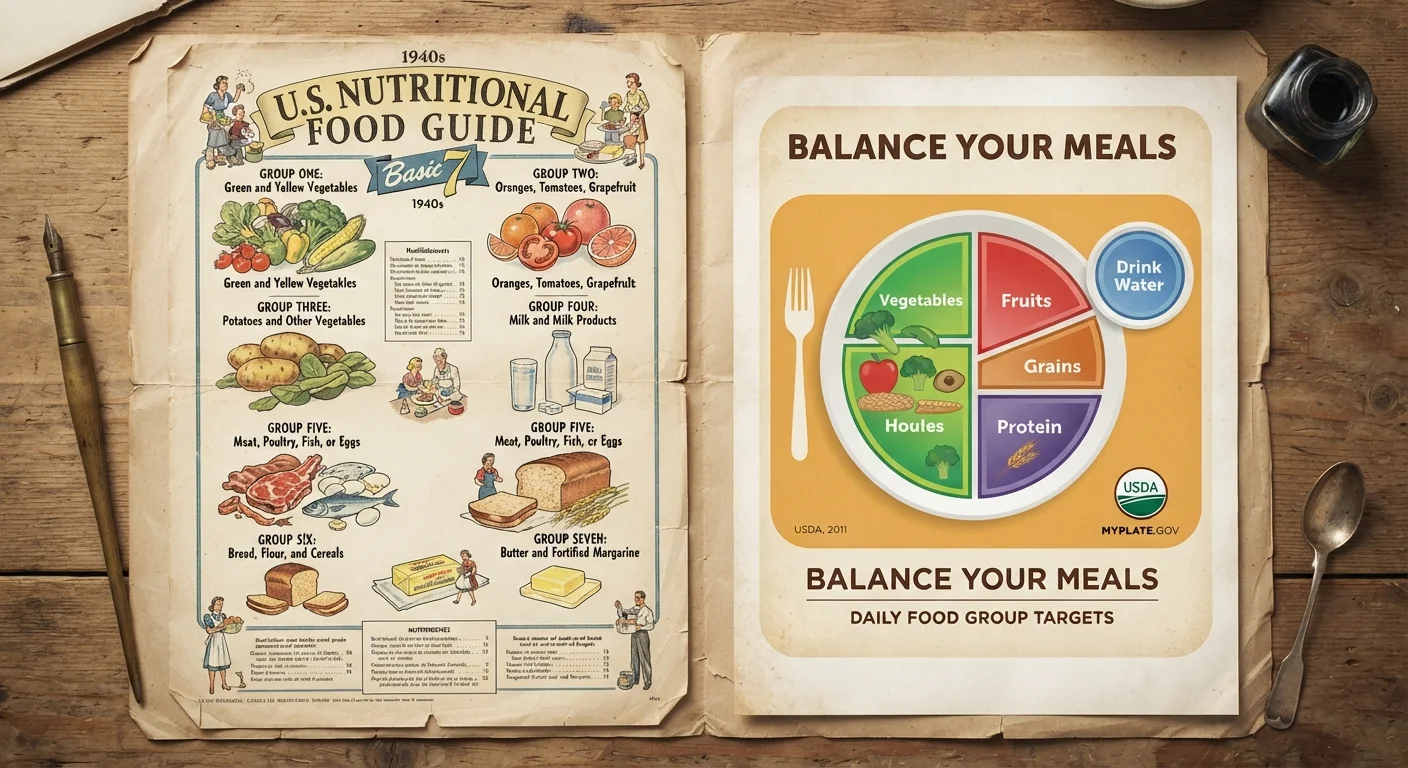
Through the 1930s and 1940s, guidance shifted in response to wartime rationing and the discovery of specific vitamins and minerals. In 1943, the USDA introduced the "Basic Seven" - a wheel-shaped guide that grouped foods into seven categories and was designed to help Americans eat adequately despite wartime food shortages. It was considered complex by many, and by 1956 it was simplified into the "Basic Four" food groups: milk, meat, vegetables and fruits, and grain products. That model dominated nutrition education for nearly two decades.
Shifting Focus: From Adequacy to Chronic Disease
By the 1970s, the scientific and public health conversation around diet was changing. Research was increasingly linking eating patterns - particularly high intakes of saturated fat, sodium, and refined sugar - to rising rates of heart disease, diabetes, and other chronic conditions. In 1977, the Senate Select Committee on Nutrition and Human Needs published Dietary Goals for the United States, the first federal document to recommend that Americans reduce certain nutrients rather than simply consume more. This was a notable departure from earlier guidance, which had focused almost entirely on preventing deficiency.
The first official Dietary Guidelines for Americans followed in 1980, jointly published by the USDA and the Department of Health and Human Services (HHS). That edition introduced language still familiar today: eat a variety of foods, maintain a healthy weight, avoid too much fat and sodium, and consume alcohol in moderation. The guidelines have been updated on a five-year cycle ever since, incorporating evolving nutritional science and public health priorities.
The 1992 Food Guide Pyramid replaced the Basic Four, visually representing proportions of different food groups rather than equal servings. It became one of the most recognized health images in the country - though it was later criticized by nutrition researchers for oversimplifying complex evidence, particularly around fats and carbohydrates. For a closer look at how some of those simplifications became entrenched beliefs, see how enduring nutrition myths formed.
1980
Year of the first Dietary Guidelines for Americans
Jointly published by the USDA and HHS, marking the first time federal agencies issued unified dietary recommendations for the public.
5 years
Frequency of Dietary Guidelines updates
Each revision draws on a systematic scientific review process conducted by a federal advisory committee.
9 editions
Total Dietary Guidelines editions published
From 1980 to the current 2020-2025 edition, guidance has been revised eight times to reflect evolving nutrition evidence.
MyPlate and the Guidelines Today
In 2011, the USDA retired the Food Guide Pyramid in favor of MyPlate - a simple circular icon divided into four sections (fruits, vegetables, grains, and protein) with a smaller circle for dairy. The visual was designed to be more immediately actionable at the dinner table, focusing on meal composition rather than abstract servings. MyPlate remains the government's primary public-facing nutrition icon.
The Dietary Guidelines for Americans, now in its 2020-2025 edition, has grown substantially more nuanced. It emphasizes overall dietary patterns rather than individual nutrients, acknowledges that healthy eating looks different across cultures and lifestyles, and dedicates attention to life-stage needs from infancy through older adulthood. Recommendations are built on systematic reviews of nutrition research conducted through a federal advisory committee process.
Understanding this history helps explain why public nutrition guidance sometimes feels inconsistent - it reflects genuine scientific evolution, not arbitrary changes. Guidance on dietary fat, eggs, salt, and cholesterol has shifted over decades as research methods improved and evidence accumulated. Readers interested in separating durable findings from outdated claims will find useful context in common nutrition myths still circulating today.
For practical application, the guidelines serve as a framework, not a rigid prescription. Anyone looking to apply them to their own eating habits - or interpret what they mean on a food package - may find it helpful to start with how to read a Nutrition Facts label as a grounding reference. And because fiber is one nutrient the guidelines consistently highlight as under-consumed by most Americans, exploring what fiber is and why it matters offers a useful complement to this broader history.
Dietary Guidelines for Americans
A federal publication jointly issued by the USDA and HHS every five years, outlining evidence-based nutritional recommendations for the general U.S. population. It forms the basis for federal nutrition programs and public health education.
MyPlate
The USDA's current public nutrition icon, introduced in 2011, depicting a divided plate to illustrate recommended food group proportions at meals. It replaced the Food Guide Pyramid.
Food Guide Pyramid
A triangular visual guide used from 1992 to 2011 to communicate recommended proportions of different food groups. It was widely recognized but later criticized for oversimplifying nutritional science.
Dietary pattern
The combination of foods and beverages consumed over time, rather than any single food or nutrient. Modern dietary guidelines focus on overall patterns rather than isolated components.
Macronutrients
The three primary energy-providing nutrients in food: carbohydrates, proteins, and fats. Early U.S. nutrition research, dating to the 1890s, centered on understanding how these fueled the body.
This article is for general informational and educational purposes only and is not intended as medical or dietary advice. Consult a qualified healthcare professional for guidance tailored to your individual health needs.