

Key Takeaways
Spending limits are tangible and immediately visible
Holding physical cash makes budget limits concrete in a way that digital balances rarely do. When an envelope empties, the constraint is undeniable - no mental math or app check required.
Reduces impulsive and emotional spending
Studies in consumer behavior have found that paying with cash tends to reduce spending compared to card payments, because the act of handing over bills registers a psychological 'pain of paying.' The envelope system leverages this effect systematically.
No technology or app required to get started
The system requires nothing more than envelopes, a pen, and your income. This simplicity makes it genuinely accessible to anyone, regardless of comfort with budgeting software or smartphones.
Forces deliberate category-by-category planning
Filling envelopes requires you to actively decide how much each spending area is worth before the month begins, building the habit of intentional allocation rather than reactive spending.
Effective for people who overspend in specific categories
Rather than overhauling an entire financial plan, the envelope system allows targeted discipline in problem areas - groceries, entertainment, or dining - without disrupting other areas that are already well-managed.
Impractical for cashless and online transactions
A significant and growing share of everyday spending - online shopping, subscriptions, bill pay, and many in-store purchases - cannot be completed with cash. Households that operate primarily on debit or credit cards must either adapt the system digitally or accept gaps in coverage.
Cash offers no fraud protection if lost or stolen
Unlike credit or debit cards, physical cash lost or stolen cannot be recovered or disputed. Carrying meaningful amounts of cash each month introduces a risk that many people reasonably want to avoid.
Requires frequent cash withdrawal and allocation
Making regular trips to the bank or ATM and physically dividing cash each pay period is time-consuming. For households with busy schedules, the maintenance burden can cause the system to break down quickly.
Difficult to handle irregular or variable income
The envelope system works most cleanly with predictable paychecks. Freelancers, gig workers, and those with commission-based income often find it difficult to set consistent envelope amounts when monthly income fluctuates substantially.
Does not integrate with automated savings or bill pay
Most financial advisers recommend automating savings contributions and fixed bill payments, but these transactions bypass envelope categories entirely, making full integration awkward without a deliberate workaround.
Our Verdict
The envelope system is a time-tested budgeting framework that excels at making abstract spending limits feel real and immediate. It demands consistent cash handling and doesn't integrate naturally with modern digital payments, which limits its practicality for many households. A hybrid or digital version can preserve most of the psychological benefits while reducing friction.
Best suited for people who consistently overspend in specific categories, prefer a tactile approach to money management, or are building budgeting habits from scratch.
What the Envelope System Actually Is
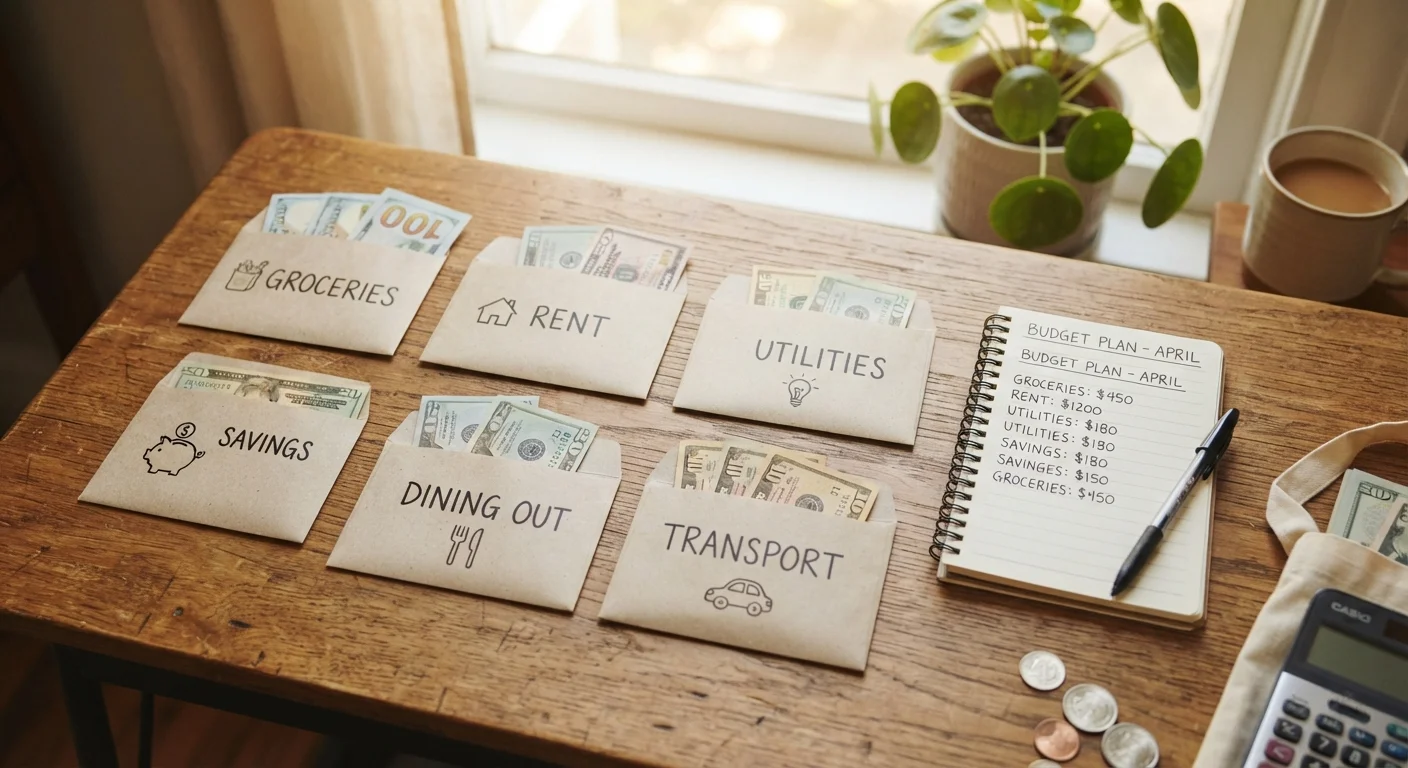
The envelope system is a cash-based budgeting method in which you divide your take-home income into physical envelopes, each labeled for a specific spending category - groceries, transportation, dining out, utilities, and so on. At the start of each budget period, usually aligned with your pay schedule, you fill each envelope with the maximum amount you've decided to spend in that category. When an envelope is empty, spending in that category stops until the next funding cycle.
The logic is straightforward: physical cash creates a hard stop that a debit card or digital balance does not. Watching a grocery envelope thin out mid-month is more viscerally real than a number decreasing on a screen. That sensory feedback is the system's primary mechanism.
The method has roots stretching back generations and was formalized and popularized by personal finance educators as a tool for people struggling to control discretionary spending. It sits within a broader family of zero-based budgeting approaches, where every dollar of income is assigned a purpose before the month begins. For a comparison with other frameworks, see how the envelope method compares to the 50/30/20 rule and pay-yourself-first.
Advantages of the Envelope Method
The envelope system's strengths are concentrated in the psychological dimension of money management - the gap between knowing a budget and actually following one.
Spending limits are tangible and immediately visible
Holding physical cash makes budget limits concrete in a way that digital balances rarely do. When an envelope empties, the constraint is undeniable - no mental math or app check required.
Reduces impulsive and emotional spending
Studies in consumer behavior have found that paying with cash tends to reduce spending compared to card payments, because the act of handing over bills registers a psychological 'pain of paying.' The envelope system leverages this effect systematically.
No technology or app required to get started
The system requires nothing more than envelopes, a pen, and your income. This simplicity makes it genuinely accessible to anyone, regardless of comfort with budgeting software or smartphones.
Forces deliberate category-by-category planning
Filling envelopes requires you to actively decide how much each spending area is worth before the month begins, building the habit of intentional allocation rather than reactive spending.
Effective for people who overspend in specific categories
Rather than overhauling an entire financial plan, the envelope system allows targeted discipline in problem areas - groceries, entertainment, or dining - without disrupting other areas that are already well-managed.
For people who track expenses manually rather than relying on apps, cash envelopes function as a real-time ledger that requires no reconciliation. See manual expense tracking methods for complementary techniques that pair naturally with this approach.
Disadvantages and Real-World Limitations
The envelope system's friction - the same quality that makes it effective - also creates practical challenges in a modern financial environment.
Impractical for cashless and online transactions
A significant and growing share of everyday spending - online shopping, subscriptions, bill pay, and many in-store purchases - cannot be completed with cash. Households that operate primarily on debit or credit cards must either adapt the system digitally or accept gaps in coverage.
Cash offers no fraud protection if lost or stolen
Unlike credit or debit cards, physical cash lost or stolen cannot be recovered or disputed. Carrying meaningful amounts of cash each month introduces a risk that many people reasonably want to avoid.
Requires frequent cash withdrawal and allocation
Making regular trips to the bank or ATM and physically dividing cash each pay period is time-consuming. For households with busy schedules, the maintenance burden can cause the system to break down quickly.
Difficult to handle irregular or variable income
The envelope system works most cleanly with predictable paychecks. Freelancers, gig workers, and those with commission-based income often find it difficult to set consistent envelope amounts when monthly income fluctuates substantially.
Does not integrate with automated savings or bill pay
Most financial advisers recommend automating savings contributions and fixed bill payments, but these transactions bypass envelope categories entirely, making full integration awkward without a deliberate workaround.
One underappreciated limitation: the system doesn't automatically build savings or an emergency buffer. Pairing it with a dedicated savings mechanism is essential. Automating savings transfers can handle that layer separately, while the envelope method governs day-to-day discretionary spending. Understanding how budgeting and emergency funds work together can help you build a more complete financial system.
Digital Envelope Systems: The Modern Adaptation
Several budgeting apps replicate the envelope structure digitally, assigning virtual spending pools to categories and preventing allocation to one area from masking a shortfall in another. These tools preserve the envelope system's core discipline - every dollar is categorized before it's spent - while working within a card-based, cashless lifestyle.
Digital Envelope Apps: What to Expect
Popular budgeting apps replicate envelope logic by letting you assign incoming dollars to virtual spending pools before the month begins. Transactions are then matched to the appropriate pool, and the app flags when a category is nearly depleted. While these tools remove the need for physical cash, they work best when you review and reconcile them regularly - the habit of checking in is what makes the psychological friction stick. Look for apps that connect to your bank accounts securely and offer clear category-level reporting.
The trade-off is reduced psychological friction. Research in behavioral economics consistently finds that digital payments feel less "real" than handing over physical bills, which means the natural spending brake built into cash envelopes is partially diluted in a virtual system. That said, for people who travel frequently, use subscription services, or pay most bills online, a digital envelope approach is far more practical than the physical alternative.
The 50/30/20 rule and zero-based envelope budgeting address spending allocation differently; neither is universally superior - the right choice depends on how you actually spend and what kind of structure keeps you accountable.
Is the Envelope System Right for You?
The envelope system is most effective for people who have identified specific spending categories where they routinely go over budget. If you can pinpoint that dining out or impulse shopping is where your plan breaks down, envelope-style constraints - physical or digital - apply targeted pressure exactly where it's needed.
~33%
Americans report having no budget at all
Gallup and similar household finance surveys have consistently found that roughly one-third of U.S. adults do not follow any formal budgeting method.
12-18%
Reduction in spending when paying with cash vs. cards
Multiple behavioral economics studies, including research from MIT and the Journal of Consumer Research, have found that consumers tend to spend meaningfully less when using cash compared to card-based payment.
It's less well-suited to households with highly variable income, people whose spending is predominantly automatic (rent, subscriptions, loan payments), or those who find cash handling burdensome. In those cases, a framework like the 50/30/20 budget rule, which works with proportional allocations rather than fixed categorical caps, may offer more flexibility.
Whatever system you choose, the goal is consistent enough execution that the behavior becomes habitual. The envelope method's real value is that its constraints are impossible to ignore - which is precisely why it continues to work for so many people decades after its introduction.
This article is for general informational and educational purposes only and does not constitute personalized financial advice. Consider consulting a qualified financial professional for guidance tailored to your specific situation.