

Key Takeaways
Why Manual Tracking Still Works
Budgeting apps automate data collection, but automation comes with a trade-off: when transactions categorize themselves, you rarely have to think about them. Research in behavioral economics consistently finds that the friction of deliberate action - writing something down, counting physical cash - increases conscious awareness of the behavior. For spending, that awareness is often exactly what's needed.
Manual tracking also has practical advantages. It doesn't require linking bank accounts to a third-party service, it works for people who deal primarily in cash, and it functions without a smartphone. For individuals rebuilding financial habits after a disruption - job loss, a medical event, a major life change - starting with pen and paper can feel less overwhelming than onboarding a new digital tool. The comparison between analog and digital approaches applies across many habit-building domains; the underlying trade-offs are similar whether you're tracking money or anything else.
What you will need
The method you choose matters less than whether you stick with it. The steps below are designed to get a manual system running in one sitting.
Setting Up and Sustaining Your System
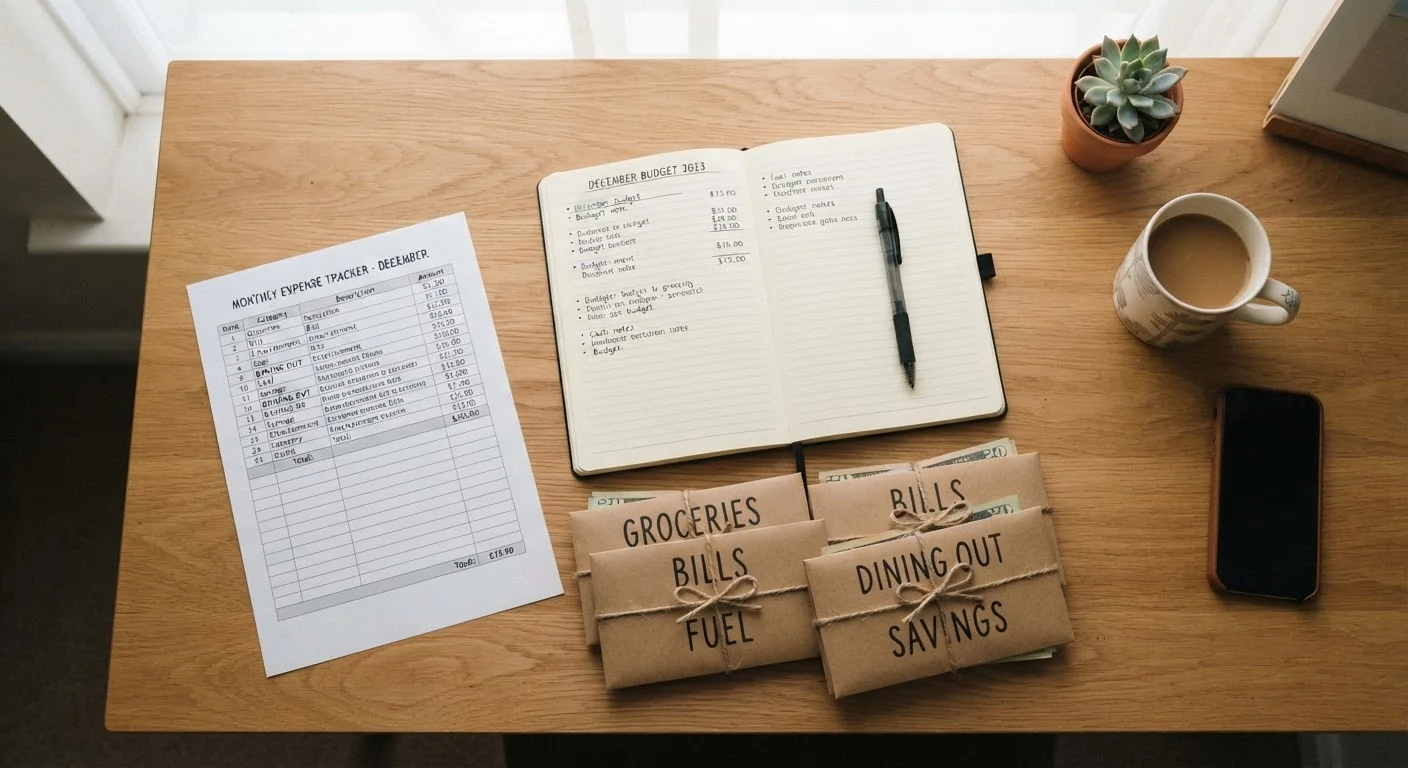
Lined notebook or pocket journal
Used as a daily spending log - record each transaction as it happens throughout the day.
Printed or digital spreadsheet
Used to organize spending by category at a weekly or monthly level for pattern analysis.
Cash envelopes
Used to physically separate spending by category so the amount remaining is always visible.
Calculator
Used to tally category totals and compare them against your income at review time.
List your income and fixed expenses
Before tracking variable spending, establish your baseline. Write down your monthly take-home income and every fixed, recurring expense: rent or mortgage, insurance premiums, minimum debt payments, and any automatic subscriptions. These numbers form the ceiling against which all other spending must fit.
Subtract fixed expenses from take-home income. The remainder is what you have available for groceries, transportation, entertainment, and everything else - the spending you'll actually be tracking.
Choose your tracking format
Select one of three proven manual formats based on your habits:
- Daily notebook log: Write down every purchase as it happens - amount, category, and brief description. This method captures the most detail and builds the strongest spending awareness.
- Weekly spreadsheet: Enter transactions once or twice a week from receipts or memory, sorted by category columns. Slightly less real-time but easier for people who prefer batch processing.
- Cash envelopes: Divide physical cash into labeled envelopes by category (groceries, dining, gas, etc.) at the start of each pay period. When the envelope is empty, that category is spent. Learn more about how this system works - and its real limitations - in our guide to the envelope system.
Mixing methods is fine. Many people use envelopes for cash-heavy categories and a notebook for card purchases.
Define your spending categories
Divide spending into 6-10 categories that reflect your real life. Common starting categories include: housing, groceries, transportation, dining out, health and medical, personal care, entertainment, clothing, and savings or debt payments.
Add a dedicated miscellaneous or irregular category for expenses that don't fit neatly elsewhere - this is where car maintenance, gifts, and unexpected copays land. Without this bucket, those costs get absorbed invisibly and distort your totals.
Record every transaction in real time
The only rule that determines whether manual tracking works: write it down before you forget it. Log each purchase - amount, category, and a short note - at the moment of spending or within a few hours. Waiting until the end of the day means reconstructing memory, which introduces gaps.
For card purchases, the transaction note on your banking statement can serve as a backup, but it should confirm your log, not replace it. The act of writing it yourself is what creates spending awareness.
Review and total your spending weekly
Set a 15-minute weekly review - the same day each week works best. Add up spending by category and compare each total to whatever limit you assigned. Note categories where you're on pace to overspend before the month ends, not after.
This weekly check-in is the step most people skip, and it's the most important. Raw data recorded but never reviewed produces no behavior change. The goal is to spot patterns: which categories consistently run over, which ones leave money on the table, and where estimates were unrealistic.
Adjust category limits based on what you find
After one full month of tracking, revise your category limits to match reality rather than ideal assumptions. If groceries consistently run $50 over budget, either increase the grocery limit (and reduce another category) or identify specific purchases driving the overage.
Manual tracking is iterative - the first month's numbers are calibration data, not a verdict on your habits. Use what you learn to build a budget that reflects your actual life, then continue tracking against those revised targets. This approach applies whether you're managing a household budget or planning a larger financial goal. For applying these habits to travel spending, the same category-by-category logic holds; see how to build a travel budget that actually holds up.
Keep Your Tracking Tool Visible
A notebook left in a drawer gets forgotten. Place your tracking journal on your desk, tape your weekly spending sheet to the refrigerator, or keep your envelope wallet at the front of your bag. Physical visibility is one of the strongest behavioral cues for maintaining a new habit.
Don't Skip Irregular Expenses
One of the most common failures in manual budgeting is tracking only predictable monthly bills and forgetting irregular costs: car repairs, dental visits, gifts, and annual subscriptions. These gaps cause budgets to feel accurate on paper but fail in practice. See which spending categories budgets most often underestimate for a detailed breakdown.
Once you've completed a full month, your recorded data becomes a baseline for realistic budgeting going forward. For ongoing savings and debt goals, the category-level clarity that manual tracking produces is directly useful - it shows exactly where margin exists. Explore broader strategies for putting that margin to work in the Saving & Debt hub.
This Is Education, Not Personal Financial Advice
The methods described here are general financial education designed to help you understand expense-tracking approaches. They are not personalized financial advice. Your specific situation - income, debt, obligations - may call for guidance from a licensed financial professional.
This article is for general informational and educational purposes only and does not constitute personalized financial advice. Consult a qualified financial professional for guidance specific to your situation.