

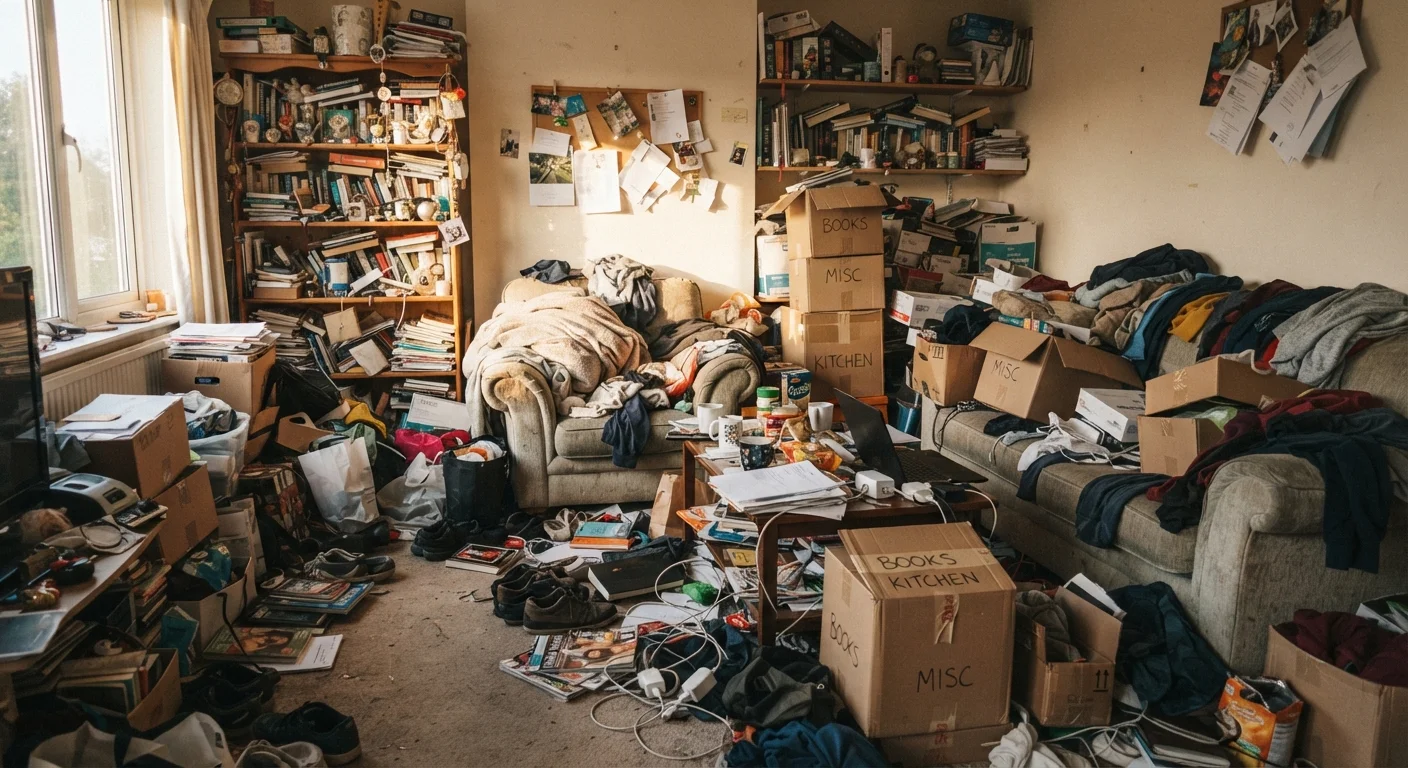
Key Takeaways
Useful items prevent repeat purchases
Keeping functional tools, equipment, and supplies on hand avoids the cost and inconvenience of renting or rebuying items when needed again.
Sentimental objects support psychological wellbeing
Research in environmental psychology suggests meaningful possessions can reinforce identity and continuity, particularly during periods of change or loss.
Preparedness items have genuine practical value
Emergency supplies, seasonal gear, and backup equipment serve real household functions - their value may not be visible day-to-day but emerges when needed.
Collections and hobbies enrich daily life
Items tied to active hobbies, creative pursuits, or family activities represent ongoing investment in quality of life, not simply accumulated clutter.
Clutter elevates measurable household stress
Studies have found associations between disordered home environments and elevated cortisol, particularly among adults who spend a significant portion of their day at home.
Excess volume drives ongoing storage costs
Spending on bins, shelving, and off-site storage units is often a recurring expense that scales with accumulation rather than solving the underlying problem.
Disorganized spaces slow everyday tasks
When belongings exceed a home's organized capacity, routine tasks - finding items, clearing surfaces, cleaning - take measurably longer each day.
Over-accumulation can mask spending patterns
Homes filled with underused or duplicate items often reflect habitual purchasing that, when examined, conflicts with savings or debt-reduction goals.
Full storage prevents practical organization
When every cabinet and shelf is at capacity, new or frequently used items have nowhere logical to go, creating surface clutter and compounding disorder.
Our Verdict
Chronic over-accumulation rarely feels like a problem until the costs start compounding - in cleaning time lost, storage space rented, and low-level stress that's hard to trace back to its source. Weighing those costs honestly against the genuine value certain possessions hold is the first step toward a more functional, calmer home.
Anyone feeling overwhelmed by the volume of belongings in their home and looking for a clear-eyed framework to start making changes.
What 'Too Much Stuff' Actually Costs
Most households don't think of clutter in financial terms, but the costs are real and recurring. Storage solutions - bins, shelving units, off-site storage units - represent ongoing spending driven largely by volume. According to industry estimates, self-storage is one of the fastest-growing real estate categories in the U.S., suggesting many households have more than their homes can comfortably hold.
Beyond direct spending, excess possessions cost time. Studies on household labor consistently find that disorganized environments slow down routine tasks: finding keys, locating tools, clearing surfaces before cooking. That friction accumulates into hours across a week. There's also a less-visible cost - the mental load of managing, maintaining, and remembering what you own.
1 in 10
American households renting self-storage
Industry data from the Self Storage Association has estimated that approximately one in ten U.S. households rents self-storage space.
~$100/mo
Average monthly self-storage unit cost
Storage unit rental costs vary widely by location and size, but national averages commonly fall in the range of $80-$150 per month for a standard unit.
The money mindset behind accumulation matters too. Items kept "just in case" or out of guilt often represent money already spent that can't be recovered - a concept sometimes called sunk cost thinking. Holding onto those items doesn't recoup the investment; it just extends the cost in space and attention.
The Real Advantages of Keeping Things
Before treating all accumulation as a problem, it's worth acknowledging what possessions genuinely provide. Some items deliver clear, ongoing utility - tools used regularly, equipment that saves repeated rental costs, clothing suited to multiple seasons. Letting go of genuinely useful things can mean repurchasing them later at greater expense.
Useful items prevent repeat purchases
Keeping functional tools, equipment, and supplies on hand avoids the cost and inconvenience of renting or rebuying items when needed again.
Sentimental objects support psychological wellbeing
Research in environmental psychology suggests meaningful possessions can reinforce identity and continuity, particularly during periods of change or loss.
Preparedness items have genuine practical value
Emergency supplies, seasonal gear, and backup equipment serve real household functions - their value may not be visible day-to-day but emerges when needed.
Collections and hobbies enrich daily life
Items tied to active hobbies, creative pursuits, or family activities represent ongoing investment in quality of life, not simply accumulated clutter.
Sentimental items occupy a distinct category. Objects tied to memory and identity carry psychological value that doesn't fit a simple cost-benefit model. Research in environmental psychology suggests that meaningful personal objects can support a sense of continuity and belonging - particularly during life transitions. For a deeper look at this dynamic, see our piece on navigating sentimental clutter.
There's also the matter of collective household needs. A family with young children, hobbies, or home-based work legitimately needs more physical infrastructure than a single-person household. Context shapes what "too much" actually means.
The Documented Downsides of Over-Accumulation
When volume tips past a household's functional capacity, the downsides become harder to ignore. Cluttered environments have been associated in research with higher cortisol levels - a physiological marker of stress - particularly for those who spend significant time at home. If you're curious about how this kind of ambient pressure affects health over time, our overview of how stress accumulates covers the mechanisms in more detail.
Clutter elevates measurable household stress
Studies have found associations between disordered home environments and elevated cortisol, particularly among adults who spend a significant portion of their day at home.
Excess volume drives ongoing storage costs
Spending on bins, shelving, and off-site storage units is often a recurring expense that scales with accumulation rather than solving the underlying problem.
Disorganized spaces slow everyday tasks
When belongings exceed a home's organized capacity, routine tasks - finding items, clearing surfaces, cleaning - take measurably longer each day.
Over-accumulation can mask spending patterns
Homes filled with underused or duplicate items often reflect habitual purchasing that, when examined, conflicts with savings or debt-reduction goals.
Full storage prevents practical organization
When every cabinet and shelf is at capacity, new or frequently used items have nowhere logical to go, creating surface clutter and compounding disorder.
Clutter also has a compounding effect on household systems. When storage is perpetually full, new items have nowhere to go - which leads to surfaces becoming default storage, which increases cleaning time, which adds to the overall sense of disorder. Breaking that cycle usually requires reducing volume, not adding more storage. Our article on common storage myths explores why buying more bins tends to make the problem worse rather than better.
Moving Toward a More Intentional Home
The goal isn't a minimalist aesthetic - it's a home where what you keep earns its place. That framing shifts decluttering from a one-time purge to an ongoing practice of evaluation. Two structured approaches worth knowing: the one-in, one-out rule (every new item displaces an existing one) and zero-based decluttering (periodically reassessing all possessions from scratch). Our comparison of these two methods breaks down which works better for different households.
Decluttering Isn't the Same as Minimalism
Reducing excess doesn't require adopting any particular aesthetic or lifestyle philosophy. The practical goal is simply ensuring that what you keep has a clear function or meaning - and that volume doesn't exceed what your home can hold in an organized way. There is no universal right amount of possessions; the measure is whether what you own is working for you or against you.
Interestingly, the same principle applies beyond physical space. If your digital life feels as cluttered as your closets, the approach of intentional reduction translates directly - see our guide to cleaning up an overcrowded phone for a practical parallel.
Start with the areas generating the most daily friction - not the most emotionally complex ones. Clearing high-traffic zones first creates visible, immediate relief, which tends to build momentum for tackling harder decisions later.