

Key Takeaways
Why Popular Storage Advice Often Backfires
Home organization content is everywhere - and much of it is built around products, aesthetics, and quick fixes rather than lasting behavioral change. The result is that many homeowners invest real time and money into systems that look functional but quietly make daily life harder. Understanding where common storage wisdom goes wrong is the first step toward building something that actually holds.
The myths below aren't obscure - they're repeated constantly in magazines, social media, and home improvement content. That familiarity is exactly what makes them worth examining carefully.
Myth
If I just had more bins, baskets, and organizers, my home would finally be tidy.
Fact
Adding storage containers to an unedited collection of belongings usually compounds the problem rather than solving it.
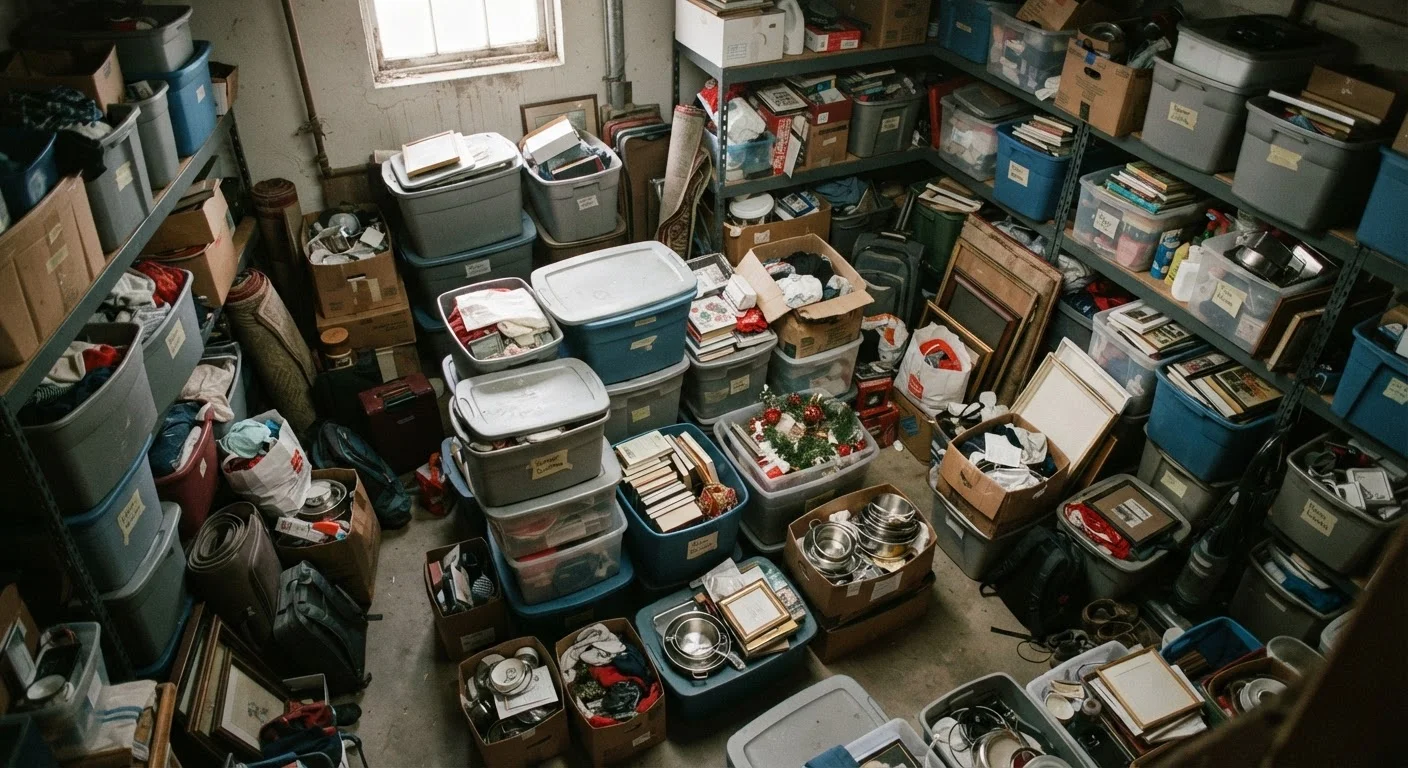
Storage products are a solution to a space problem, not a clutter problem. When you add bins before reducing what you own, you're essentially giving mess a permanent address. Professional organizers consistently note that decluttering - actually removing items from the home - must come before any organizational system is introduced. As our piece on the real costs of keeping too much stuff explores, excess belongings carry ongoing costs in time and mental energy, regardless of how neatly they're stored.
Myth
Everything needs a perfectly labeled, matching set of containers to stay organized.
Fact
Visual uniformity can actually hide contents and slow retrieval, making a space feel tidy while functioning poorly.
Matching opaque bins look great in photos but often mean you can't quickly see what's inside. Studies on cognitive load in domestic environments suggest that retrieval ease - being able to find something in seconds - matters far more for sustained organization than visual uniformity. Clear containers, loose groupings, or even simple shelf sections often outperform elaborate matching systems for everyday household use. The goal is a system your whole household will actually maintain.
Myth
Items should be stored based on category, not location - all batteries together, all tools together.
Fact
Storing things close to where you use them reduces friction and dramatically improves how well a system holds up over time.
Pure category-based storage sounds logical but ignores how people actually move through a home. If your most-used screwdriver lives in a basement tool chest but you need it most often in the kitchen for appliance repairs, it'll end up on the counter anyway. Zone-based organization principles prioritize proximity to use over categorical purity - and they tend to stick much longer as a result.
Myth
The best way to declutter is to go room by room, one space at a time.
Fact
Decluttering by category across the whole home - rather than by location - gives a more accurate picture of what you actually own.
When you tackle a single room, similar items scattered across the house don't get counted. You might cull ten books from the bedroom while fifty more sit in the living room, office, and garage - never confronting the full volume. Gathering every item in a category before making keep-or-release decisions gives a truer sense of quantity and makes it easier to let go of duplicates or rarely used items.
Myth
Once you get organized, maintenance takes care of itself.
Fact
Even well-designed systems require regular upkeep and occasional full resets as life circumstances change.
Households shift - kids' needs change, hobbies evolve, people move in or out. A system built for last year's life may not fit this year's. Why organizing systems fall apart often comes down to failing to revisit and adjust them. Building a brief seasonal review into your routine - even 30 minutes per zone - prevents gradual drift from eroding the whole structure.
Myth
Sentimental items should be kept out of any decluttering conversation - they're simply non-negotiable.
Fact
Sentimental belongings can be meaningfully edited without discarding what truly matters to you.
Treating sentimental items as entirely off-limits means they can quietly consume significant storage space over years. A more thoughtful approach involves choosing the pieces that carry the most meaning and finding dignified ways to handle the rest - digitizing photos, passing items to family members, or curating a meaningful display rather than boxing everything indefinitely. Our article on navigating sentimental clutter explores this process in depth.
What a Functional Storage System Actually Looks Like
A home that's genuinely easy to manage isn't necessarily the one that looks the most organized in photographs. It's the one where every household member can find what they need, put it back without effort, and where clutter doesn't steadily accumulate in corners and on counters.
Storage Systems Only Work If You Use Them
A beautifully organized space that requires too many steps to maintain will revert to clutter within weeks. Any system you set up needs to match how your household actually behaves day to day - not an idealized version of it. Friction is the enemy of consistency. If putting something away feels harder than leaving it out, the system will lose.
Practical organization tends to share a few consistent traits: items live near where they're used, the number of belongings fits the available space without forcing it, and the maintenance burden is low enough that real people with real schedules can keep up with it. If your current setup doesn't meet that bar, the answer is rarely more storage - it's usually a combination of editing what you own and rethinking where things live.
For spaces that present a particular challenge, garage zoning and seasonal rotation strategies offer a concrete model for applying these principles to one of the most commonly cluttered areas in American homes.
The broader pattern here mirrors what we see in other areas of home management - myths persist because they feel intuitive, not because they work. For a parallel look at how misconceptions affect repairs rather than storage, see common home repair myths that cost homeowners time and money.