

| V-Strip Best Location | Door side jambs, double-hung window channels |
| Foam Tape Best Location | Window sashes, attic hatches, low-traffic edges |
| Door Sweep Best Location | Bottom of exterior doors |
| Bulb/Tubular Seal Best Location | Top and latch-side of exterior doors, garage doors |
| Silicone Seal Best Location | High-temp or high-UV exposure areas, garage doors |
| Surface Prep Required | Clean, dry, free of old adhesive before installation |
Why the Type of Weather Stripping Matters
Not all gaps are the same, and not all weather stripping is interchangeable. Using the wrong type for a particular location can mean premature wear, poor sealing, or even interference with how a door or window operates. The goal is to match each material's physical properties - flexibility, compression range, durability, and surface compatibility - to the specific gap it will fill and the movement it will endure.
Before choosing a material, measure the gap you're sealing and consider how often that surface moves. A door that opens dozens of times daily needs something more durable than a window that shifts only seasonally. If your doors are already behaving oddly, it's worth reading our guide to diagnosing door problems before applying new stripping - a gap caused by a warped frame won't be fixed by sealing alone.
| V-Strip Best Location | Door side jambs, double-hung window channels |
| Foam Tape Best Location | Window sashes, attic hatches, low-traffic edges |
| Door Sweep Best Location | Bottom of exterior doors |
| Bulb/Tubular Seal Best Location | Top and latch-side of exterior doors, garage doors |
| Silicone Seal Best Location | High-temp or high-UV exposure areas, garage doors |
| Surface Prep Required | Clean, dry, free of old adhesive before installation |
The Main Types and Where They Belong
V-Strip (Tension Seal)
V-strip, also called tension seal or pile weatherstrip, is a folded piece of plastic or metal that springs open to fill a gap. It installs inside the channel where a door or window slides or pivots, pressing against the moving surface continuously. It works especially well along the sides of double-hung windows and the side jambs of doors because it stays hidden when the door is closed and tolerates repetitive movement without flattening.
Foam Tape
Closed-cell foam tape is one of the most accessible options and suits low-traffic applications where compression is the primary sealing mechanism. It's best used on window sashes, cabinet doors, attic hatches, and any surface that compresses fully when closed. Because foam tape degrades with repeated friction and UV exposure, avoid using it on high-traffic exterior door edges where constant rubbing will break it down quickly.
Door Sweeps
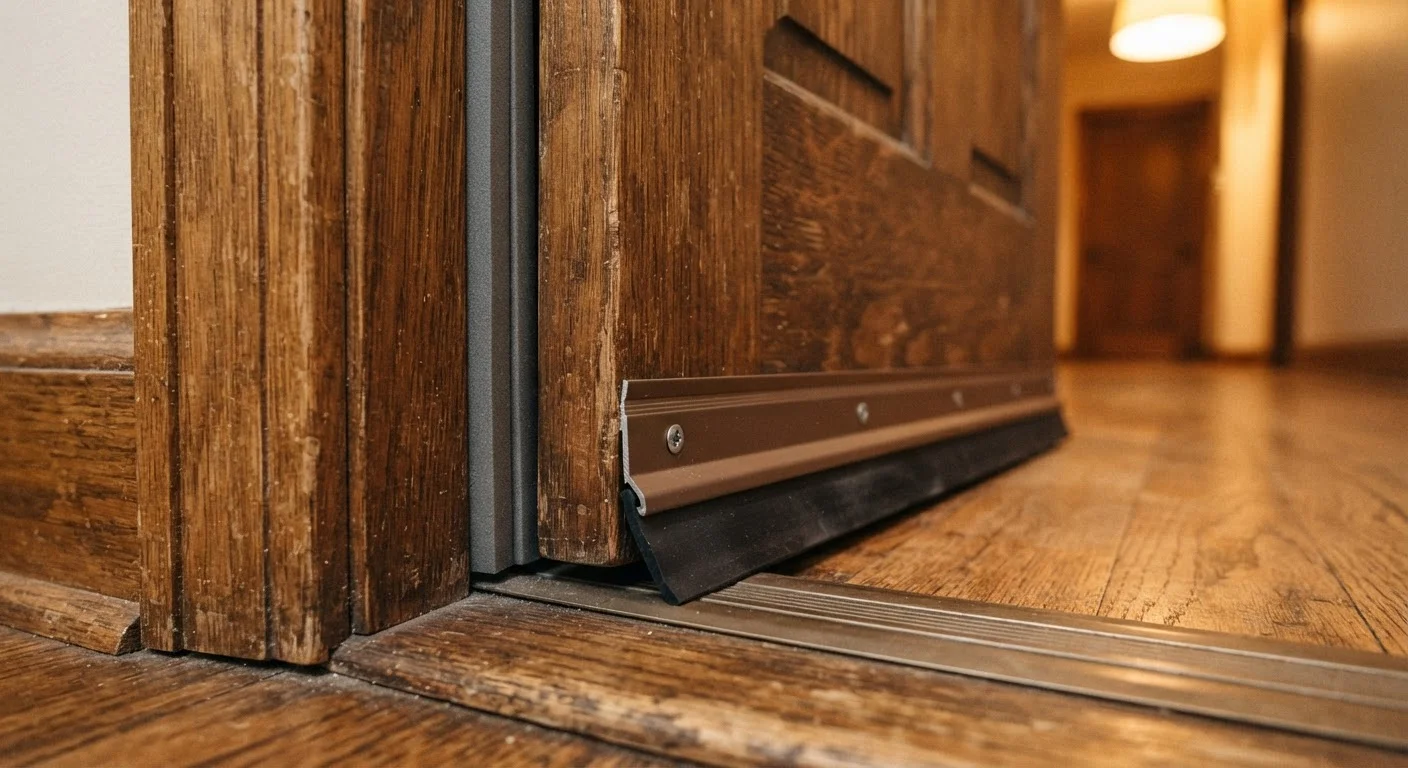
A door sweep attaches to the interior bottom of an exterior door and drags or presses against the threshold to block drafts, insects, and moisture from entering at floor level. Automatic door sweeps lift slightly when the door opens and drop when it closes, reducing floor drag. These are the correct choice for any gap at the base of an exterior door, particularly where there's no threshold or the existing one sits low.
Door Shoes and Threshold Seals
Where a door sweep addresses the bottom of the door panel, a door shoe or threshold insert addresses the threshold itself. These sit on top of or within the threshold and create a compression seal when the door closes. They're suited to high-traffic entries where a dragging sweep would wear prematurely.
Bulb or Tubular Rubber/Vinyl
Bulb-shaped or tubular stripping compresses against a surface when a door closes, creating a tight seal around door stops and frames. It's commonly used on the top and latch-side of exterior doors and on garage doors. The rounded profile accommodates slight variations in gap width, making it more forgiving on older frames that aren't perfectly uniform.
Reinforced Silicone Seals
Silicone-based weather stripping is highly durable and tolerates temperature extremes, making it a suitable choice for garage doors, entry doors in climates with dramatic seasonal swings, and areas exposed to direct sunlight. It resists brittleness in freezing temperatures better than many foam or rubber alternatives.
Tension Seal (V-Strip)
A folded strip of metal or plastic that springs outward to fill a gap in a sliding or hinged channel. It provides continuous contact without requiring compression.
Door Sweep
A strip attached to the bottom of a door that presses against the threshold or floor to block drafts, insects, and moisture from entering at the base.
Compression Seal
A type of weather stripping that works by being squeezed between two surfaces when a door or window closes, forming a tight barrier.
Closed-Cell Foam
A type of foam in which air pockets are sealed off from each other, making it resistant to moisture absorption. Commonly used in weather stripping tape.
Threshold Seal
A sealing insert mounted on or within the door threshold that creates a compression point when the door panel closes against it.
Installation Basics and Common Mistakes
Regardless of type, all weather stripping installs on a clean, dry surface. Residual dust, oil, or old adhesive will prevent proper bonding and cause premature failure. Use a household cleaner and let the surface dry completely before applying any new material.
A few mistakes are common across all types:
- Over-compressing foam tape - crushing foam beyond its rated range prevents the door from closing fully or creates uneven pressure that cracks the tape.
- Leaving gaps at corners - cut each strip to meet precisely at corners rather than overlapping or leaving small open segments.
- Ignoring door alignment - weather stripping cannot compensate for a door that doesn't close squarely. Address fit issues first.
- Mixing adhesive-backed strips on painted surfaces without primer - adhesive may pull paint on removal; test in a small area if concerned.
Matching material to location isn't complicated once you understand the basic principle: high-traffic and friction-heavy spots need durable, resilient materials, while low-movement sealed edges can use compressible foam. Apply the same logic you'd use when choosing the right sealant for the right joint - context always dictates material.
When to Call a Professional
Weather stripping is a straightforward DIY task in most cases, but if gaps are caused by structural settling, a warped frame, or foundation movement, no amount of stripping will provide a lasting fix. If you notice doors that have significantly shifted or frames that are visibly out of square, consult a licensed contractor to assess the underlying cause before investing in new materials.