

Key Takeaways
Automated reminders reduce reliance on memory
Push notifications prompt you to log habits at the right time, making consistency easier to maintain without extra mental effort.
Visual data tracks progress over time
Charts, streak counters, and completion rates give you an instant overview of patterns that would take significant effort to compile manually.
Always accessible on a device you carry everywhere
Logging a habit in the moment - right after a workout or a glass of water - requires no extra materials and takes only seconds.
Flexible scheduling for non-daily habits
Many apps allow you to set habits for specific days of the week or a set number of times per week, which paper grids can make awkward to track.
Writing by hand deepens engagement and memory
The physical act of handwriting involves more cognitive processing than tapping a screen, which can make the reflection feel more meaningful and memorable.
No notifications means no screen-time creep
Opening a notebook doesn't expose you to unrelated notifications or app distractions, making it easier to stay focused on the task of reflection.
Fully customizable without developer constraints
You can design any layout you want - color-coded grids, combined habit-and-mood logs, weekly reviews - without being limited to a platform's existing templates.
No subscription costs or data privacy concerns
Paper journals require no account creation, no ongoing fees, and carry no risk of your tracking data being stored or shared by a third party.
Our Verdict
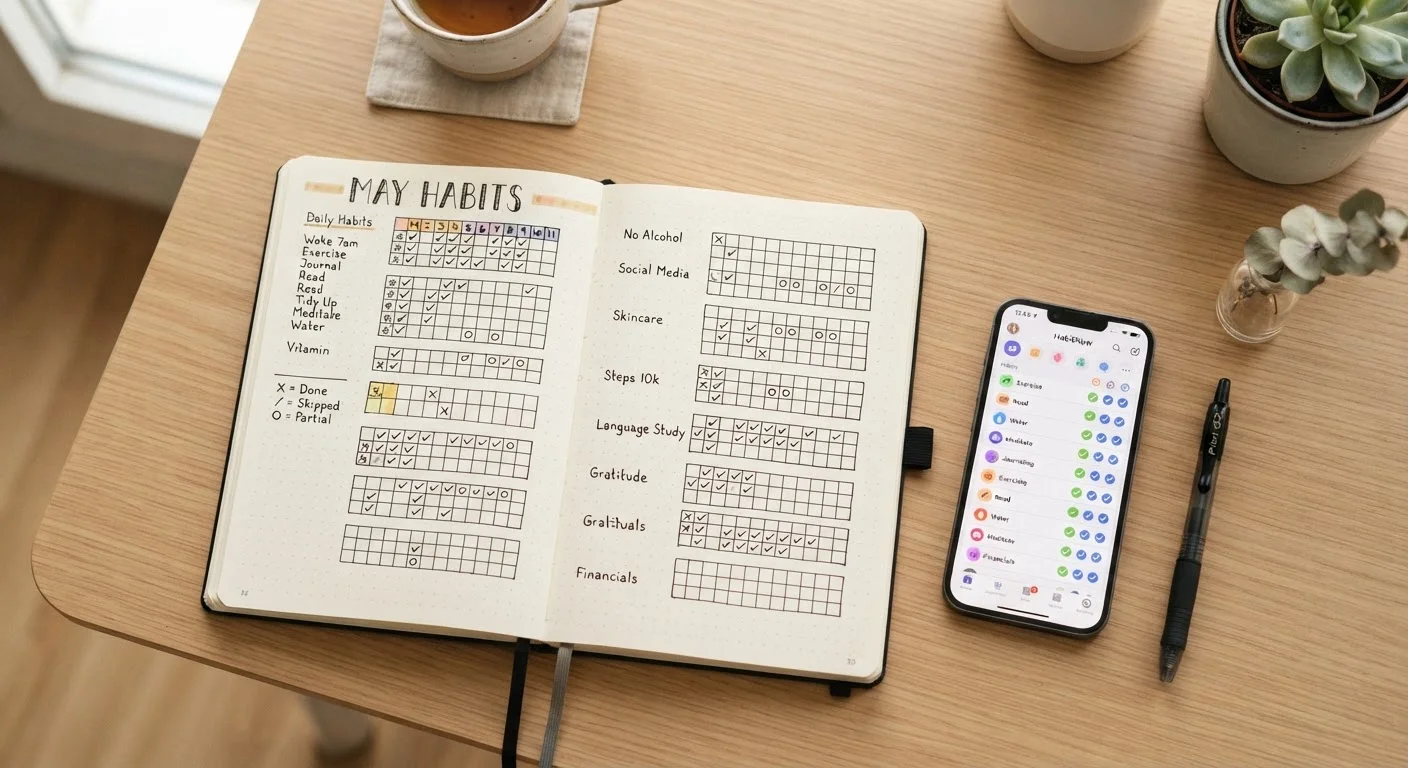
Habit tracking apps and paper journals both have genuine merit, and the science of behavior change supports either tool when used consistently. Apps suit people who want frictionless logging, data trends, and built-in accountability nudges. Paper journals suit those who value tactile engagement, distraction-free focus, and the slower, more intentional rhythm of writing by hand.
Anyone starting a new habit-building routine - whether they prefer a screen or a notebook - as long as they commit to a consistent, realistic tracking practice that fits their daily life.
Why Habit Tracking Works in the First Place
Before weighing the tools, it helps to understand why tracking habits at all makes a difference. Research in behavior science consistently shows that self-monitoring - simply observing and recording your own actions - increases follow-through. The act of logging a behavior creates a feedback loop: you see what you did, and that visibility motivates you to keep going.
This principle holds whether you're checking a box in a notebook or tapping a streak counter on your phone. The mechanism is the same; the experience is not. That difference in experience is where the real trade-offs begin.
If you're also exploring how journaling supports mental well-being beyond habit tracking, see journaling formats worth trying for a breakdown of different approaches and what each one offers.
The Case for Habit Tracking Apps
Digital habit trackers have expanded significantly in recent years, and their popularity reflects real practical benefits.
Automated reminders reduce reliance on memory
Push notifications prompt you to log habits at the right time, making consistency easier to maintain without extra mental effort.
Visual data tracks progress over time
Charts, streak counters, and completion rates give you an instant overview of patterns that would take significant effort to compile manually.
Always accessible on a device you carry everywhere
Logging a habit in the moment - right after a workout or a glass of water - requires no extra materials and takes only seconds.
Flexible scheduling for non-daily habits
Many apps allow you to set habits for specific days of the week or a set number of times per week, which paper grids can make awkward to track.
Apps can send push notifications at set times, removing the need to remember on your own. Many platforms also generate streak counts, charts, and completion rates - data that can surface patterns you'd never notice manually. If you log a workout every morning for three weeks, an app can show you that in seconds.
Convenience is also a meaningful factor. Your phone is almost always with you, which lowers the barrier to logging a habit in the moment. Some apps sync across devices, allow habit tagging by category, and let you set flexible schedules - for habits that happen three times a week rather than daily, for instance.
For those curious about the broader landscape of wellness-focused digital tools, the honest trade-offs of using mental wellness apps offers a useful parallel perspective.
The Case for Paper Journals
Paper-based habit tracking has existed far longer than any app, and its staying power reflects something apps have not fully replicated.
Writing by hand deepens engagement and memory
The physical act of handwriting involves more cognitive processing than tapping a screen, which can make the reflection feel more meaningful and memorable.
No notifications means no screen-time creep
Opening a notebook doesn't expose you to unrelated notifications or app distractions, making it easier to stay focused on the task of reflection.
Fully customizable without developer constraints
You can design any layout you want - color-coded grids, combined habit-and-mood logs, weekly reviews - without being limited to a platform's existing templates.
No subscription costs or data privacy concerns
Paper journals require no account creation, no ongoing fees, and carry no risk of your tracking data being stored or shared by a third party.
Writing by hand engages the brain differently than tapping a screen. Studies on handwriting and memory suggest that the physical act of writing tends to support deeper processing and retention. When you draw a small checkmark or write a note about why you skipped a habit, you're doing something cognitively richer than a tap.
Paper journals are also distraction-free by design. Opening your tracker doesn't expose you to notifications, social feeds, or app badges competing for your attention. For people who find their phone a source of distraction, a notebook can be a meaningful boundary.
There's also a personalization dimension that apps rarely match. A paper journal can be anything: a simple grid, a color-coded chart, or a page that combines habit tracking with morning reflection. If you want to connect habit tracking with broader self-reflection practices, different journaling formats can offer inspiration for combining the two.
A Note on Habit Complexity
Simple, frequent habits - drinking water, taking a daily walk - tend to be easier to track with either method. More complex or variable habits, like managing a fitness regimen with multiple components, may benefit from the structured logging and flexibility that apps provide. Consider how complex your target habits are before committing to a format.
Where Each Method Falls Short
Apps can create a false sense of productivity. Logging a habit is not the same as building one, and the gamification elements in some apps - streaks, badges, leaderboards - can shift focus from the habit itself to the reward of the counter. When a streak breaks, some users abandon the habit entirely rather than simply resuming.
Paper journals, meanwhile, require discipline without any external prompts. If you forget to bring your notebook or skip a few days, there's no reminder pulling you back. Data review is also manual: identifying trends across weeks or months means flipping through pages and doing the math yourself.
40%
Of daily actions driven by habit, not decisions
Research published in the journal Psychological Science estimates that roughly 40% of daily behaviors are habitual rather than consciously chosen.
66 days
Average time for a new habit to become automatic
A study published in the European Journal of Social Psychology found that, on average, it took 66 days for a new behavior to become automatic - not the commonly cited 21 days.
New to productivity apps in general? getting started with productivity apps provides a beginner-friendly guide to easing in without overwhelm.
Choosing What Actually Works for You
The most honest answer is that the best habit-tracking method is whichever one you'll return to consistently. A sophisticated app left unopened after two weeks accomplishes nothing. A plain notebook used daily accomplishes everything.
A few practical questions can help you decide: Do you tend to have your phone nearby at habitual moments - morning routines, workouts, mealtimes? An app may fit naturally. Do you find your phone a distraction, or do you already keep a planner or journal? Paper may be the better fit.
A hybrid approach is worth considering, too. Some people use an app for quick daily logging and a paper journal for weekly reflection - combining the speed of digital with the depth of analog. The goal isn't to find the perfect system. It's to build habits that last.
This article is for general informational and educational purposes only. It is not a substitute for guidance from a qualified health or wellness professional regarding your individual circumstances.