

Key Takeaways
Why smart people make predictably irrational financial decisions
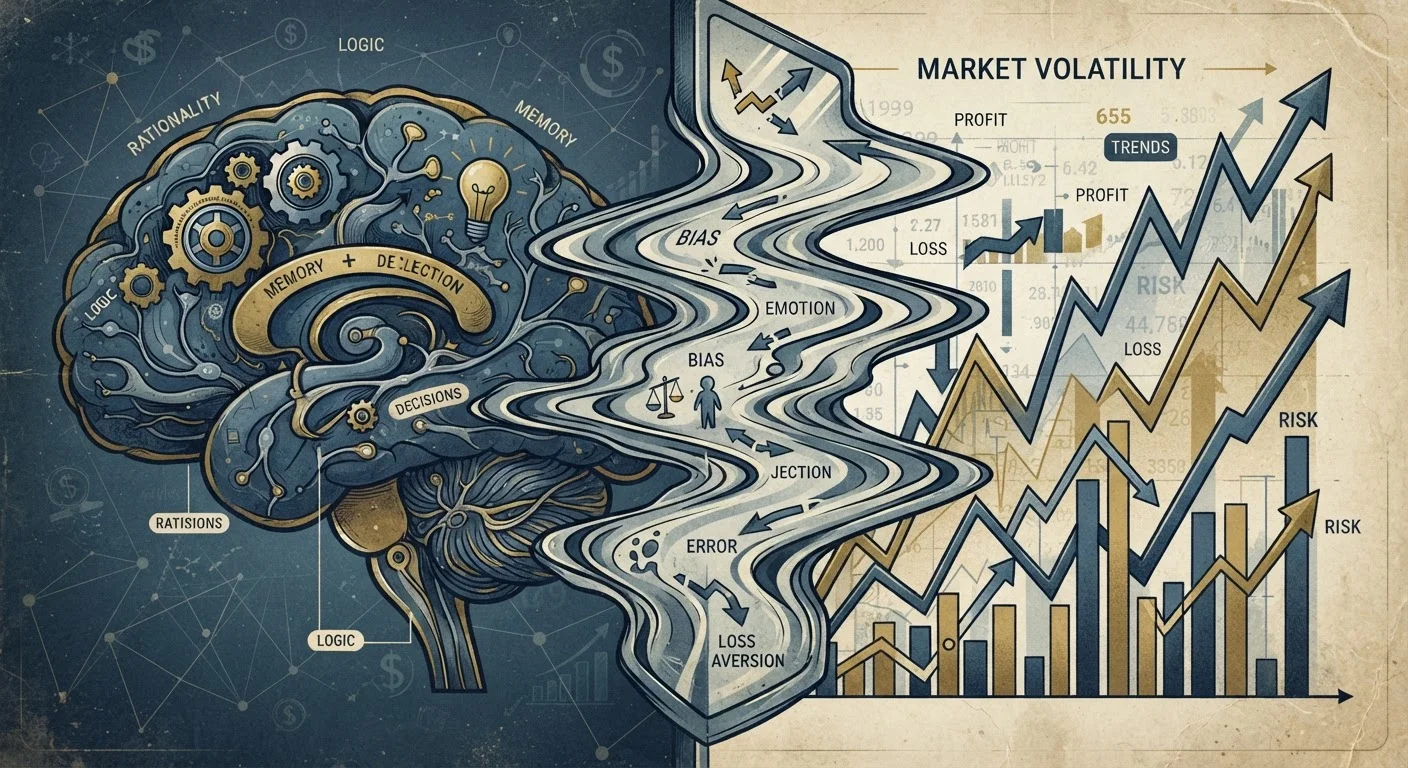
Most people assume their financial choices are driven by logic: they weigh the options, consider the costs, and decide rationally. But decades of research in behavioral economics - the field that examines how psychology influences economic behavior - demonstrates that human financial decision-making is systematically skewed by cognitive biases: mental shortcuts the brain uses to process information quickly, often at the cost of accuracy.
These biases are not signs of low intelligence or weak character. They are features of the human cognitive architecture, present across education levels and income brackets. The challenge is that they operate largely below conscious awareness, shaping financial choices in ways most people never notice. Understanding the most common ones - and how they interact with everyday money decisions - is a foundational step toward more deliberate financial behavior. This kind of psychological inventory pairs naturally with exploring the cognitive patterns behind overspending, where similar forces are at work.
Anchoring: The first number shapes every number after it
Anchoring occurs when an initial piece of information - a price, a salary figure, a loan amount - serves as a mental reference point that disproportionately influences all subsequent judgments. In financial contexts, this is pervasive. A car dealer's sticker price anchors the negotiation even when the figure bears no relationship to fair market value. A credit card's minimum payment figure anchors how much people think they owe each month, even though paying only the minimum costs far more in interest over time.
The corrective is deliberate re-anchoring: before entering any financial negotiation or evaluating any offer, research independent benchmarks. Know the average refinance rate, the market rent in your area, or the fair value of a vehicle before any figure is placed in front of you.
The first number you see shapes every financial judgment that follows it.
Loss aversion: Losses sting roughly twice as hard as gains feel good
Behavioral economists have documented that the psychological pain of losing a given sum tends to outweigh the pleasure of gaining an equivalent amount - often by a ratio estimated around 2:1. This asymmetry, identified through decades of research in the field of behavioral economics, has direct consequences for financial behavior.
Loss aversion can cause people to hold onto underperforming investments far too long because selling would make the loss feel real and final. It can also lead to excessive risk aversion with emergency savings, keeping money in low-yield accounts out of fear of any scenario where it might diminish. Understanding that this bias is hardwired - not a personal failing - makes it easier to create rules for yourself rather than relying on in-the-moment emotional evaluation. This connects directly to the broader emotion-money connection that behavioral research has consistently documented.
Loss aversion keeps people locked in poor financial positions to avoid the pain of confirming a loss.
Present bias: The future self feels like a stranger
Present bias describes the tendency to over-weight immediate rewards relative to future ones, even when waiting would produce a meaningfully better outcome. This is why retirement contributions are perpetually delayed despite people knowing they are important. The future version of yourself who will need that money feels abstract and distant; the present version who could spend it feels immediate and real.
Research in behavioral economics suggests that psychological distance from the future self functions similarly to distance from a stranger - we discount their needs accordingly. Automatic enrollment in workplace retirement plans was designed precisely to counter this bias by removing the active choice and making saving the default. If your situation allows it, automating savings before the money reaches your checking account is one of the most evidence-supported ways to work around present bias rather than fight it head-on. For a practical starting point, budgeting frameworks can help you build a structure that accounts for this tendency.
Automating savings removes the in-the-moment temptation that present bias exploits.
Mental accounting: Not all dollars are treated as equal
Mental accounting is the habit of treating money differently depending on its perceived source or designated purpose, rather than treating all dollars as fungible. Windfall money - a tax refund, a bonus, an inheritance - is often spent more freely than earned income, even though both represent identical purchasing power. Similarly, people will simultaneously carry high-interest credit card debt and maintain a low-yield savings account, because the accounts are mentally categorized as separate pools.
Recognizing mental accounting in your own behavior requires tracking money at the household level, not account by account. Paying down a 20% APR credit card balance with savings earning 4% is almost always mathematically preferable, but mental accounting makes that logic feel emotionally counterintuitive. The saving and debt strategies that hold up best tend to treat all dollars as interchangeable.
A dollar of windfall money spends no differently than a dollar of earned income - but we treat them as if they do.
Confirmation bias: Seeking evidence that validates what we already believe
Confirmation bias leads people to favor information that supports existing beliefs and discount information that challenges them. In personal finance, this can manifest as selectively reading news that validates a financial decision already made, or dismissing sound advice that contradicts a current strategy. Someone convinced they are good at picking investments may unconsciously remember their wins more clearly than their losses.
This bias is particularly relevant when evaluating inherited money beliefs. If you grew up hearing that debt is always dangerous, you may unconsciously filter out nuanced information about when strategic borrowing makes sense. Childhood financial beliefs often persist into adulthood precisely because confirmation bias reinforces them. A useful counter-practice: actively seek out the strongest argument against your current financial position before committing to it.
Confirmation bias causes people to hear the financial advice that agrees with them and tune out the rest.
The status quo bias: Inertia as a financial strategy
Status quo bias is the preference for the current state of affairs - not out of informed satisfaction, but simply because changing requires effort and any change is perceived as a potential loss. Financially, this shows up when people stay in underperforming investment allocations, remain with the same bank despite better options existing, or avoid revisiting a budget set years ago.
Inertia is not neutral. Costs and conditions change; what was a reasonable default five years ago may not be today. The antidote is scheduled review: putting recurring calendar reminders to audit recurring expenses, insurance premiums, and savings rates removes the burden of motivation. The goal is to make deliberate continuation - not inertia - the operating principle. This kind of self-examination is exactly what structured money behavior prompts are designed to facilitate.
Financial inertia isn't a neutral default - unchanged conditions still produce compounding costs and missed opportunities.
Moving from awareness to action
Recognizing these biases is genuinely useful - but awareness alone has limits. Research consistently shows that simply knowing about a bias does not reliably prevent it from influencing behavior. The more effective approach is structural: building financial habits and systems that reduce the cognitive load on any individual decision.
Build systems, not just awareness
Knowing about a cognitive bias rarely neutralizes it on its own. The most durable approach is to design financial systems - automatic transfers, scheduled reviews, written decision rules - that reduce the moment-to-moment influence of biased thinking. Awareness opens the door; structure keeps it open.
This is general financial education
The concepts discussed in this article reflect established behavioral economics research and are intended for educational purposes only. They are not personalized financial advice. For guidance tailored to your specific circumstances, consult a qualified financial adviser or planner.
For those ready to examine their own patterns more closely, self-reflection prompts for money behavior offer a structured starting point. And if some of these biases feel deeply familiar, it may be worth examining how a fixed versus growth mindset shows up in financial life - because the way you think about your ability to change may itself be shaped by the same cognitive patterns described here.
This article is for general informational and educational purposes only and does not constitute personalized financial advice. Readers should consult a qualified financial professional before making decisions about their individual financial circumstances.