

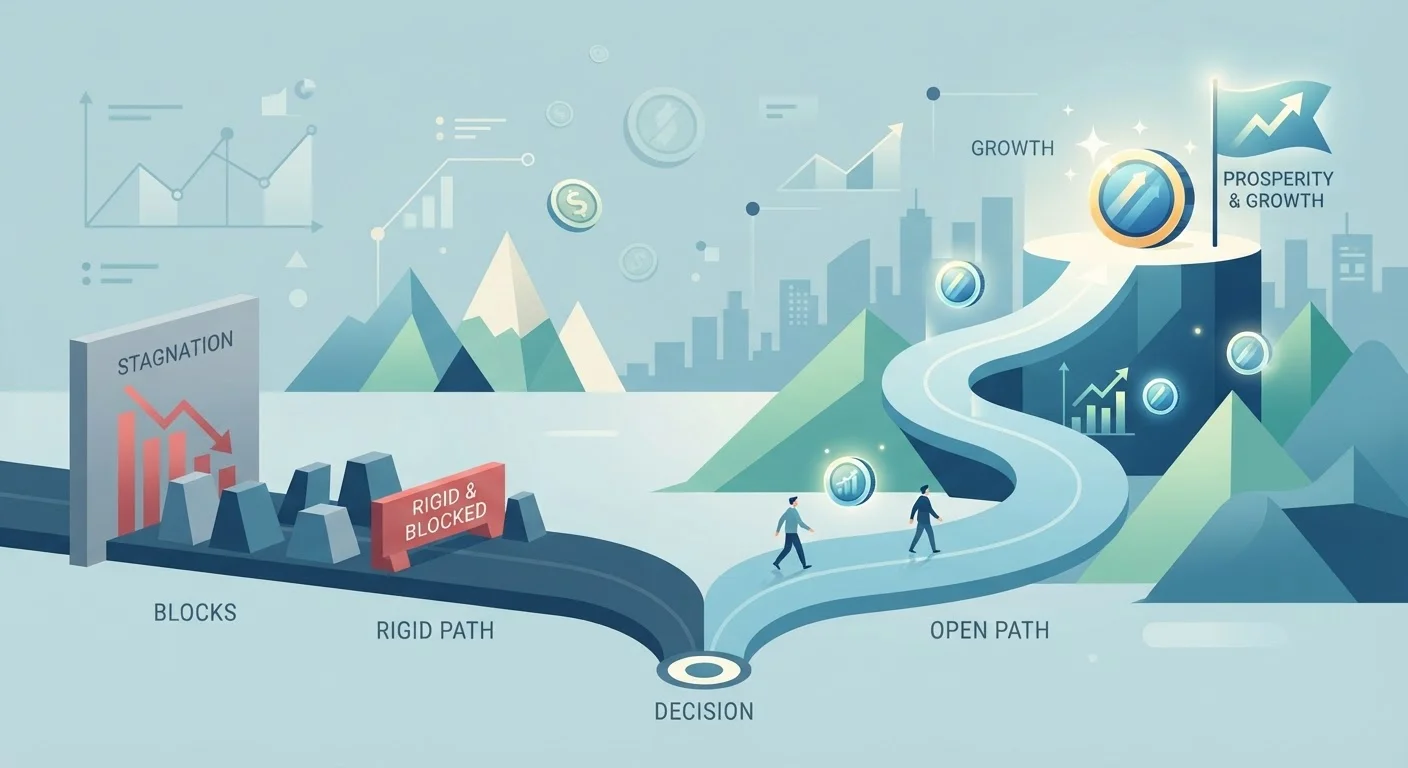
Key Takeaways
Option A
Fixed Mindset
The belief that financial ability is innate and largely unchangeable.
Best for: Understanding a mental pattern to recognize and move past - not a framework to adopt.
Option B
Growth Mindset
The belief that financial skills and habits can be learned and improved over time.
Best for: Anyone seeking to build lasting financial confidence, resilience, and adaptability.
If you find yourself avoiding bank statements or budgets out of fear
Growth Mindset
Avoidance is a hallmark of fixed thinking. Approaching finances with curiosity rather than judgment opens the door to real change.
If you've tried and failed at financial goals and want to understand why
Growth Mindset
A growth orientation reframes failure as data, not identity - making it easier to adjust strategy rather than abandon the effort.
If you're exploring the psychology behind your financial habits
Growth Mindset
Recognizing fixed-mindset patterns in yourself is the first step toward replacing them with behaviors that compound positively over time.
Where Dweck's Framework Meets Your Wallet
Psychologist Carol Dweck's research on fixed and growth mindsets - originally focused on academic achievement - maps surprisingly well onto personal finance. The core insight: people who believe their abilities are fixed tend to avoid challenges that might expose their limitations. Those with a growth orientation embrace difficulty as part of learning. In the context of money, this distinction plays out every time someone avoids opening a credit card statement, skips learning about investing because it feels "too complex," or decides they're simply "not a numbers person."
To understand how your own beliefs about money form and persist, see what a money mindset is and why it matters. It provides essential context for recognizing which orientation is driving your financial decisions.
| Criterion | Fixed Mindset | Growth Mindset |
|---|---|---|
| Response to financial mistakes | Shame, avoidance, withdrawal | Reflection, adjustment, re-engagement |
| View of financial skills | Innate - you either have them or don't | Learnable through effort and practice |
| Reaction to debt | Identity-level failure | A problem to understand and resolve |
| Approach to new financial topics | Avoidance ("too complicated for me") | Curiosity and incremental learning |
| Long-term financial resilience | Lower - setbacks feel permanent | Higher - setbacks feel solvable |
| Budgeting behavior | Inconsistent; abandoned after failure | Iterative; revised until it works |
How Each Mindset Shows Up in Everyday Money Behavior
A fixed mindset in finance often looks like this: after overspending one month, a person concludes they're "just bad with money" and stops tracking expenses altogether. The belief becomes self-reinforcing - no tracking means no evidence of progress, which confirms the original belief. Debt feels like proof of inadequacy rather than a temporary condition to address systematically.
A growth mindset, by contrast, treats a missed savings goal as information. What caused the shortfall? Was the target realistic? What one adjustment could help next month? This orientation supports the habit-building that underlies solid budgeting fundamentals - not because growth thinkers are inherently disciplined, but because they don't interpret stumbles as permanent verdicts.
57%
Americans report financial anxiety
According to the American Psychological Association's recurring Stress in America surveys, money consistently ranks as a leading source of stress for a majority of U.S. adults.
3x
More likely to seek financial help
Research in behavioral economics suggests that individuals who attribute financial difficulty to changeable habits - rather than fixed traits - are significantly more likely to seek out financial education or counseling.
The difference also shows up in how people respond to financial setbacks like job loss or medical debt. Fixed thinkers may feel paralyzed or shame-driven; growth thinkers are more likely to seek new information, consult resources, or revise their approach. For a practical look at saving and debt strategies, the behavioral starting point matters as much as the tactical one.
Shifting from Fixed to Growth in Financial Life
Mindset is not destiny. Fixed thinking often develops from early experiences - financial instability in childhood, messages that money is shameful or mysterious, or repeated exposure to financial stress without any modeled coping strategies. Understanding these origins is explored in depth in the behavioral side of finance.
Practical shifts toward a growth orientation don't require dramatic overhauls. They tend to involve small, deliberate changes: reading one article about a financial topic you've avoided, asking one clarifying question before dismissing a new strategy, or rewriting an internal narrative from "I always overspend" to "I'm learning to recognize my spending triggers." For those starting without a financial foundation at all, building a money mindset from scratch offers a structured starting point.
Mindset Interacts With Other Money Beliefs
Fixed and growth orientations don't operate in isolation. They interact with scarcity versus abundance thinking - a related but distinct psychological dimension. Someone with a fixed mindset may also hold scarcity beliefs, compounding avoidance. For a closer look at how those two frameworks compare, see scarcity vs. abundance mindset. Understanding multiple layers of financial belief gives a more complete picture of your behavioral patterns.
It's also worth noting that mindset alone doesn't substitute for financial literacy or structural resources. A growth orientation creates the conditions for learning - it doesn't replace the learning itself. Combine behavioral awareness with concrete knowledge for the most durable results. Once you've reflected on which patterns resonate, self-reflection questions for understanding your money behavior can help you audit where you currently stand.
This article is for general informational and educational purposes only. It does not constitute personalized financial advice. For guidance tailored to your specific circumstances, consult a qualified financial professional.