

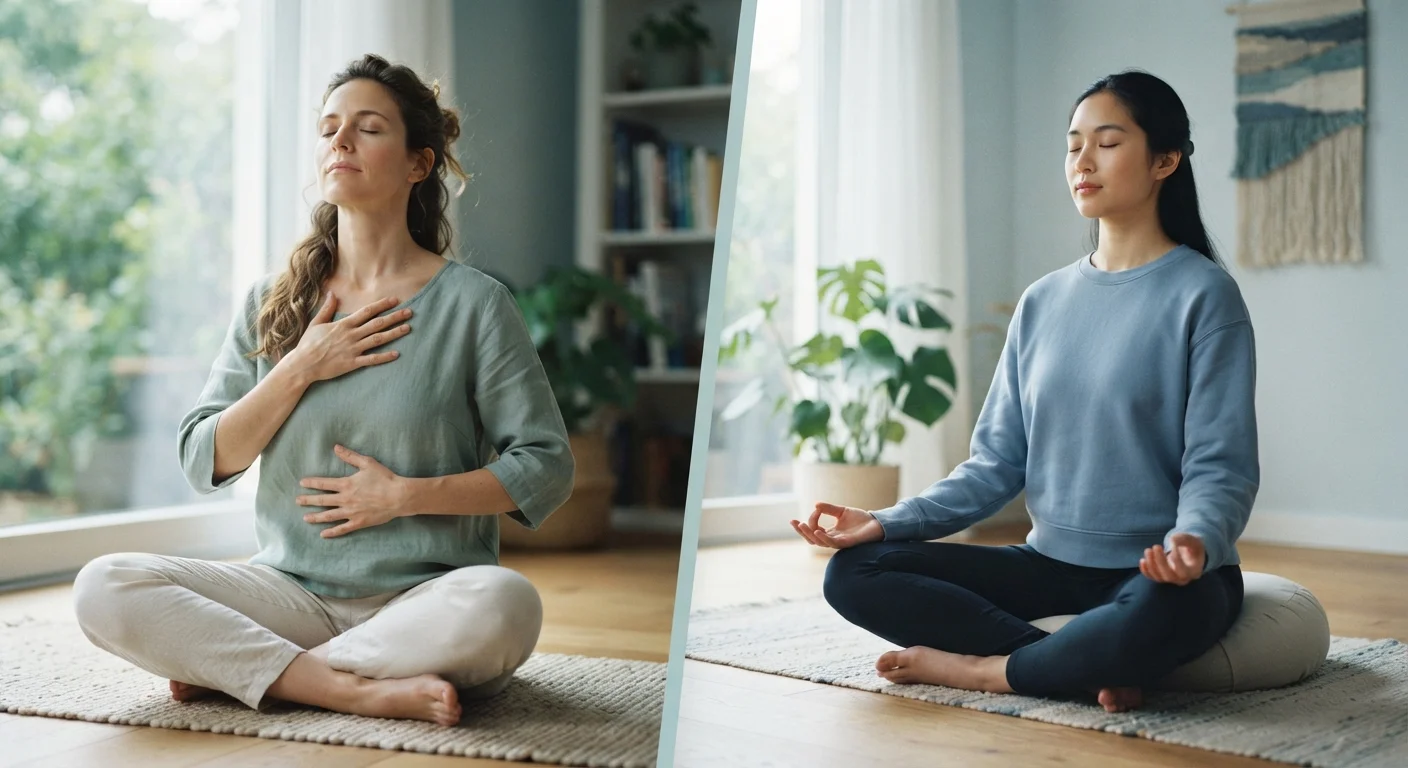
Key Takeaways
Option A
Guided Breathing
The fast-acting, physiological reset.
Best for: Best for moments when you need rapid relief from acute stress, anxiety, or physical tension.
Option B
Meditation
The long-game practice for mental clarity.
Best for: Best for building sustained emotional resilience, focus, and self-awareness over time.
If you need to calm down quickly before a stressful event
Guided Breathing
Techniques like box breathing or diaphragmatic breathing can measurably slow your heart rate within a few minutes, making them ideal for immediate situations.
If you want to build emotional resilience and mental clarity over months
Meditation
Regular meditation practice is associated with structural and functional changes in stress-related brain regions, supporting long-term well-being.
If you are new to any calming practice and want a low-barrier starting point
Guided Breathing
Breathing exercises have a concrete, easy-to-follow structure that most people can execute correctly from day one without training.
If you want a practice that complements an existing daily wellness routine
Meditation
Meditation integrates naturally into a morning or evening routine and reinforces other habits like journaling and mindful movement.
If stress has been building chronically and you want both short- and long-term support
Guided Breathing
Use breathing exercises as a daily anchor while building a meditation habit gradually - the two approaches work well together.
How Each Practice Actually Works
Guided breathing and meditation are often mentioned in the same breath, but they operate through distinct mechanisms. Understanding what each does to your body and mind helps you match the tool to the moment.
Guided breathing works primarily through the autonomic nervous system. When you consciously slow and deepen your breath - as in diaphragmatic breathing, box breathing (inhale 4 counts, hold 4, exhale 4, hold 4), or the 4-7-8 pattern - you stimulate the vagus nerve and shift the body toward parasympathetic dominance. This is the physiological state associated with rest, digestion, and recovery, often called the "rest and digest" response. The effect is relatively fast: research published in peer-reviewed journals suggests slow-paced breathing can reduce heart rate and self-reported anxiety within a few minutes of practice.
Meditation, in contrast, works more as a training regimen for attention and awareness. Practices vary widely - from focused attention (concentrating on a single object or breath) to open monitoring (observing thoughts without attachment) to loving-kindness meditation. The calming effect is real, but it builds gradually. Studies using neuroimaging have found that consistent meditators show differences in the amygdala (the brain's threat-detection center) and the prefrontal cortex, regions involved in emotional regulation. These are changes that accumulate over weeks and months, not minutes.
To understand why stress accumulates in the first place and why both practices can help, see The Science Behind Why Stress Builds Up Over Time.
| Criterion | Guided Breathing | Meditation |
|---|---|---|
| Time to noticeable effect | 2-5 minutes | Weeks to months of practice |
| Primary mechanism | Autonomic nervous system regulation | Attention training and neuroplasticity |
| Learning curve | Low - technique is immediate | Moderate - requires habit formation |
| Session length | 2-10 minutes | 5-30+ minutes typical |
| Use case | Acute stress, pre-event calm | Long-term resilience, focus |
| Equipment needed | None | None (apps optional) |
| Portability | Very high - any location | Moderate - benefits from quiet space |
Practical Differences: Effort, Access, and Daily Life
Knowing how each practice works is only half the picture. The other half is how realistically you can fit it into your day.
Guided breathing requires no equipment, no prior experience, and almost no quiet space - you can do box breathing at a work desk, in a car before a difficult conversation, or on a short break. The technique is the guide; you don't need an app or instructor, though both can help beginners find structure. Sessions can be as short as two to three minutes and still produce a measurable shift in how you feel.
Meditation has a steeper early curve. Many beginners find that sitting quietly with their thoughts is uncomfortable, and the common frustration - "I keep getting distracted, so I must be doing it wrong" - is itself a misunderstanding of the practice. The redirection of attention back to the chosen focus is the practice. Consistency matters more than session length, and many practitioners start with just five to ten minutes daily.
~8 weeks
Time for meditation to show measurable stress reduction
Research on Mindfulness-Based Stress Reduction (MBSR) programs generally uses an eight-week structure, after which participants commonly report reduced perceived stress.
~2-3 min
Time for slow breathing to lower heart rate measurably
Multiple peer-reviewed studies indicate that slow, paced breathing at around 5-6 breaths per minute activates the parasympathetic nervous system within a few minutes.
~36%
Of U.S. adults who have tried meditation
National Health Interview Survey data indicate roughly one in three American adults has tried meditation at some point, though regular practice rates are considerably lower.
Both practices benefit from being embedded in a broader daily routine. If you're interested in how structure supports emotional balance, Building a Daily Routine That Supports Emotional Stability offers a practical framework for doing exactly that.
Choosing the Right Practice - or Combining Both
The most honest answer is that guided breathing and meditation aren't competing options - they address different time horizons of stress management. Breathing exercises are your acute tool; meditation is your long-term investment.
A practical approach many people find effective: use a brief breathing exercise (two to five minutes) as an entry point at the start of a meditation session. The physiological settling that breathing produces can make it easier to sustain the quieter attention that meditation requires. Over time, each reinforces the other.
You can assess how well either practice fits your current habits using a structured reflection. Our Daily Mental Wellness Audit is a practical checklist for doing exactly that. For a broader look at what the evidence supports across stress-management techniques, Daily Stress Management: Approaches That Hold Up Under Research Scrutiny provides a useful reference.
When to Seek Professional Support
Guided breathing and meditation are wellness tools, not treatments for clinical anxiety disorders, PTSD, or other diagnosed mental health conditions. If stress or anxiety is significantly affecting your daily functioning, sleep, or relationships, these practices are not a substitute for professional care. A licensed therapist, psychologist, or psychiatrist can help you determine whether additional support is appropriate.
This article is for general informational and educational purposes only and does not constitute medical or mental health advice. If you are experiencing significant anxiety, depression, or other mental health concerns, please consult a qualified healthcare or mental health professional.