

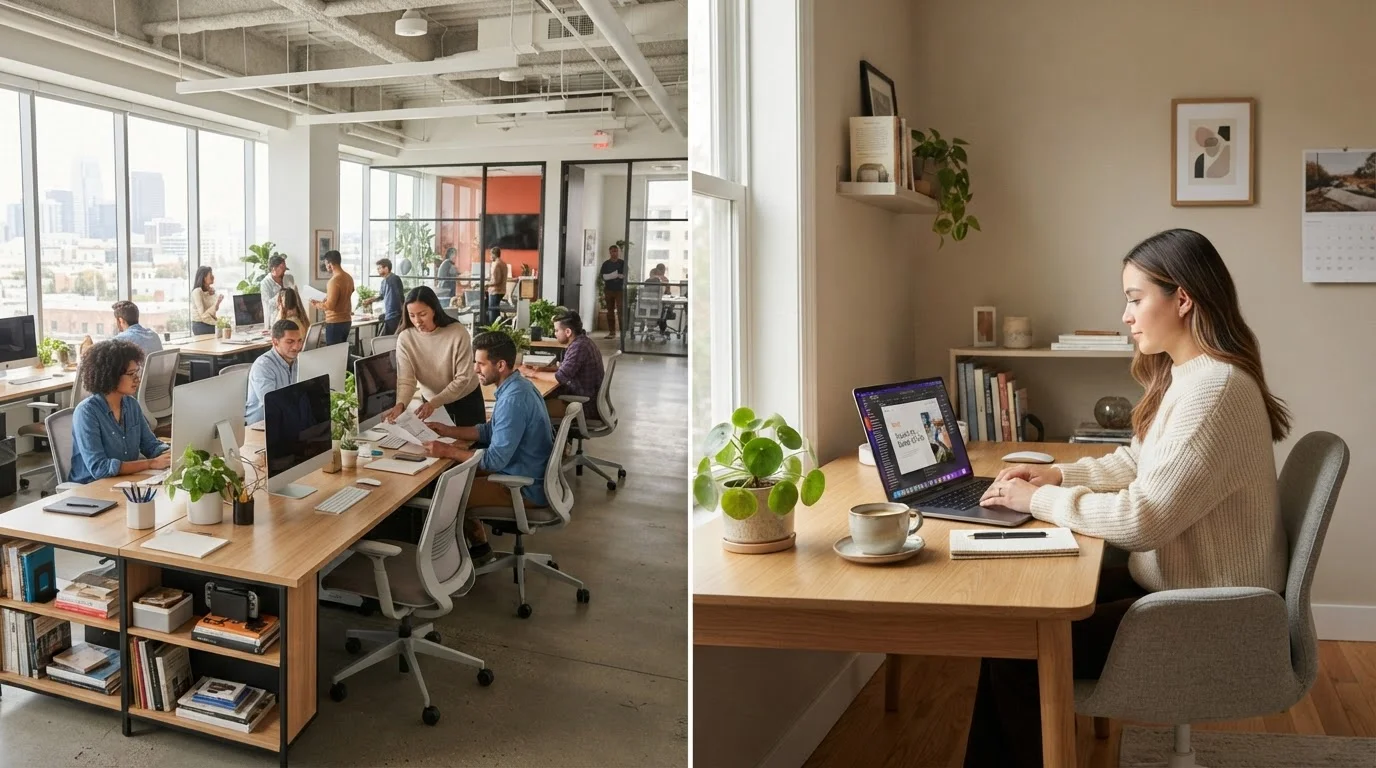
Key Takeaways
Option A
Remote Work
The flexible, autonomy-driven arrangement.
Best for: Self-directed professionals who can build visibility intentionally and thrive with fewer in-person touchpoints.
Option B
In-Office Work
The traditional, proximity-driven environment.
Best for: Workers who benefit from organic mentorship, real-time collaboration, and direct face time with decision-makers.
If you're early in your career and want mentorship and fast skill development
In-Office Work
In-person environments offer spontaneous learning moments, easier access to mentors, and more chances to demonstrate potential to senior staff.
If you're an experienced professional managing deep-focus, independent work
Remote Work
Remote arrangements tend to reward self-sufficiency and output quality - strengths established professionals are better positioned to leverage.
If career advancement requires cross-functional relationships and internal sponsorship
In-Office Work
Proximity still correlates with sponsorship in many organizations; in-person contact builds the informal trust that precedes promotion conversations.
If you need to balance personal obligations while maintaining career momentum
Remote Work
Remote roles reduce commute burden and scheduling friction, freeing bandwidth for skill-building, side projects, or continued education.
The Visibility Problem - and Why It Matters
One of the most documented career risks in remote work is reduced visibility. When managers and senior leaders don't see you regularly, your contributions can go unnoticed - even if your output is strong. Researchers who study organizational behavior sometimes call this proximity bias: the tendency for managers to favor employees they interact with in person.
This doesn't mean remote workers are automatically passed over, but it does mean the career-building work has to be more intentional. Remote professionals who want to advance typically need to be more vocal about their accomplishments, more consistent in requesting feedback, and more proactive in building relationships across the organization.
Strategic visibility isn't the same as performing busyness - it means ensuring the right people understand your contributions and see your growth over time. That applies in both settings, but the mechanisms differ significantly.
| Criterion | Remote Work | In-Office Work |
|---|---|---|
| Day-to-day visibility | Lower; requires active management | Higher by default through presence |
| Mentorship access | Structured; requires initiative | Often organic and informal |
| Promotion readiness signals | Output-based; must be communicated | Presence + output; easier to demonstrate |
| Cross-team networking | Intentional and scheduled | Incidental and frequent |
| Focus and deep work | Easier to control environment | More interruptions; open plans vary |
| Skill development pace | Self-directed; slower informally | Faster through observation and proximity |
| Work-life balance flexibility | Higher scheduling autonomy | Fixed hours; less flexibility |
Collaboration, Mentorship, and the Informal Network
In-office environments generate informal touchpoints that are genuinely difficult to replicate remotely: a conversation in the hallway before a meeting, a casual lunch with a senior colleague, or being pulled into a project because you happened to be nearby. These interactions build the social capital that often precedes advancement.
Remote workers can build professional networks intentionally - through scheduled one-on-ones, virtual coffee chats, and active participation in meetings - but it requires consistent effort. Many remote professionals find that connections with colleagues outside their immediate team weaken over time without deliberate maintenance.
Early-career workers may feel this gap most acutely. Mentorship often develops organically in person; remotely, it tends to require explicit outreach and structured programs. If you're in a role where interpersonal skills and relationship-building are core to advancement, the in-office environment creates more natural conditions for demonstrating them.
64%
Remote workers concerned about career advancement
According to a Pew Research Center survey, roughly 64% of remote workers said working from home has made it harder to feel connected to their coworkers.
1 in 3
Managers admit proximity bias in promotions
A survey by the Society for Human Resource Management found that a significant share of managers acknowledged they sometimes favor in-person employees when making advancement decisions.
Long-Term Trajectory: Output vs. Presence
Over a longer horizon, the remote vs. in-office question becomes less about day-to-day productivity and more about how your career develops. In-office workers often benefit from incidental exposure to leadership decisions, strategy conversations, and organizational change - the kind of context that shapes how you think about your field and your role within it.
Remote workers, by contrast, often develop stronger written communication skills, greater autonomy, and a reputation for self-management - all transferable strengths. Understanding which skills travel well across roles and industries becomes especially important if you're building a career primarily in distributed environments.
Thinking about where you want to be in the medium and long term is worth the time. Aligning your work arrangement with your actual goals - rather than defaulting to what's convenient - is a form of career planning that many workers overlook. See our piece on balancing short-term and long-term career goals for a practical framework to think this through.
Hybrid Arrangements Add Complexity
Many workers now operate in hybrid models - splitting time between home and office. This can offer benefits from both arrangements, but it also introduces new challenges: inconsistent face time, unclear expectations, and the risk of missing key in-person moments. If you're in a hybrid role, it's worth clarifying with your manager which days and interactions carry the most weight for visibility and development - don't assume the arrangement is symmetrical.