

Key Takeaways
Our Verdict
Short-term and long-term career goals aren't rivals - they're partners. Short-term goals create the conditions for long-term success, while long-term goals give short-term choices their meaning. The most effective approach treats both as a continuously updated system rather than a one-time exercise.
| Best for | Recommended |
|---|---|
| Those early in their career or starting from scratch | Prioritise short-term goals first |
| Those mid-career feeling directionless or stuck | Anchor with a long-term goal, then work backward |
| Those with clear ambitions but inconsistent follow-through | Build a milestone bridge between both goal types |
| Those at a major life or career transition point | Reassess and realign both goal types simultaneously |
What Short-Term and Long-Term Goals Actually Mean
Before you can balance these two goal types, it helps to understand what each one does - and doesn't - do for your career.
Short-term career goals typically cover a window of one to two years. They're concrete and actionable: completing a certification, moving into a supervisory role, improving a specific skill, or building your professional network in a new industry. They're close enough that you can plan for them with real specificity.
Long-term career goals usually span five years or more. They tend to be broader: reaching a senior leadership position, transitioning to a new field, achieving a certain level of financial stability through your work, or building a business. They give you direction but require flexibility, since careers rarely follow a straight line.
The key distinction: short-term goals are about what you can control now; long-term goals are about where you want to end up. If you're unsure how goals relate to a broader career plan, the relationship between goals and plans is worth understanding before you go further.
Why Focusing on Only One Type Backfires
Most career planning mistakes come from overweighting one horizon at the expense of the other.
Short-term only thinking produces people who are perpetually reactive - always chasing the next opportunity, promotion, or raise without any underlying direction. Over time, this creates a fragmented resume and a sense that progress isn't adding up to anything meaningful. Each win feels good momentarily, but there's no compounding effect.
Long-term only thinking has the opposite problem. Vague five-year visions with no near-term steps stay visions. Ambition without action is just wishful thinking. Research on goal achievement consistently shows that people who define specific shorter-term milestones are significantly more likely to follow through than those who focus solely on distant outcomes.
Don't Mistake Busyness for Progress
Checking off short-term tasks can create the illusion of momentum without actual career advancement. If your short-term goals don't connect to a longer-term direction, you may be busy but not moving forward. Periodically ask whether your recent wins are building toward something, or simply keeping you occupied.
It's also worth noting that unchecked ambition - where the long-term goal becomes an obsession disconnected from current reality - can cause real harm. See when ambition gets in the way of a realistic career plan for a grounded look at that risk.
How to Connect the Two: The Milestone Approach
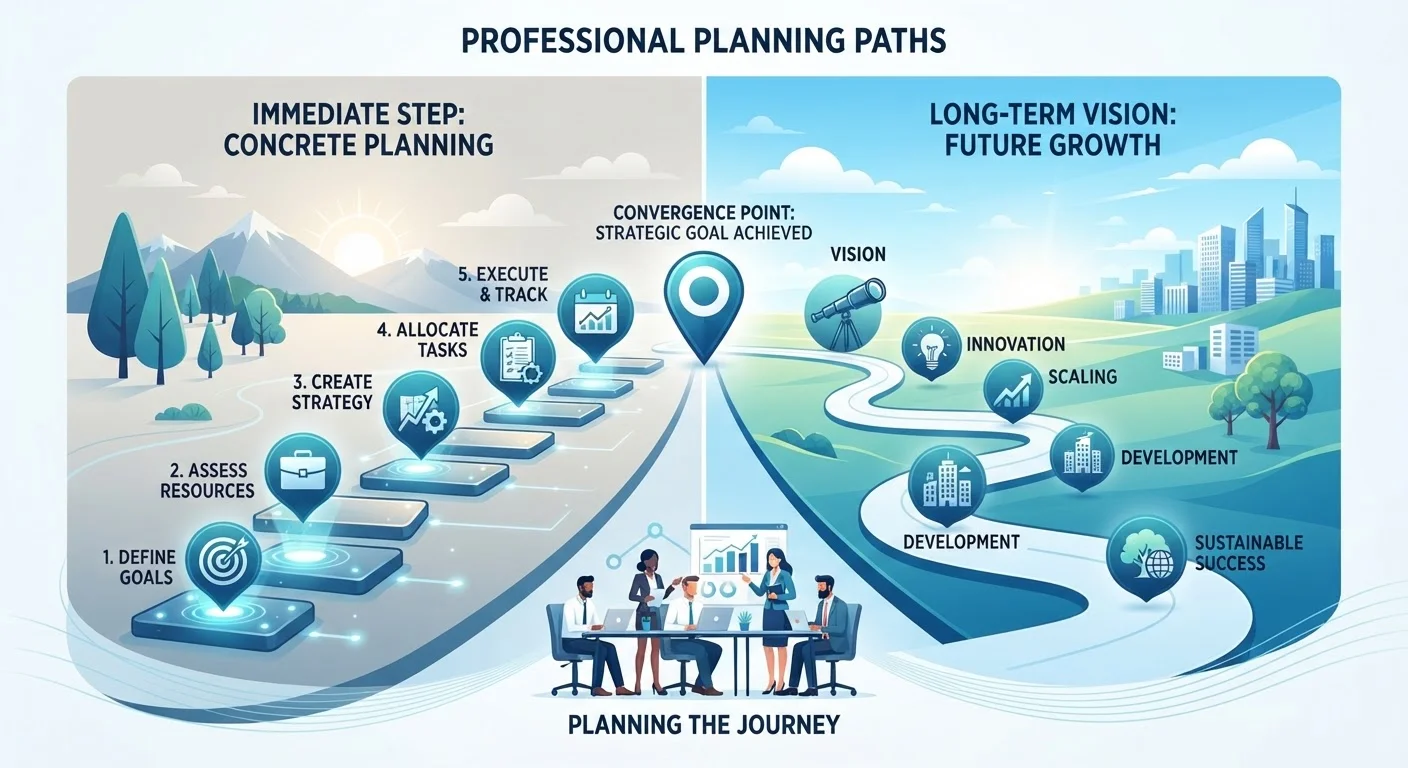
The practical answer to balancing short- and long-term goals is building structured milestones between them. Think of milestones as checkpoints - specific, time-bound markers that confirm you're on track without locking you into a rigid path.
A workable structure looks like this:
- Define your long-term goal with enough clarity to give it direction - not necessarily every detail, but the general destination.
- Work backward to identify what would need to be true in three years, then in one year, for that long-term goal to be reachable.
- Set short-term goals that directly feed those one-year benchmarks.
- Review quarterly. Careers shift. Goals that made sense six months ago may need adjusting. Build in regular reassessment, not just annual reviews.
Setting career milestones that actually work goes deeper on how to make these markers specific enough to be useful rather than aspirational-but-vague.
Start With What You Know
You don't need a fully formed long-term vision to begin. If your long-term goal is unclear, start by identifying what you want your next role or year to look like - that short-term clarity often reveals longer-term patterns. Revisit your long-term goal every six to twelve months and refine it as you learn more about what actually motivates you and where you perform best.
Adjusting the Balance Across Career Stages
The right balance between short- and long-term thinking isn't fixed - it shifts depending on where you are professionally and personally.
| Short-Term Goals | Long-Term Goals | |
|---|---|---|
| Time horizon | 1-2 years | 5+ years |
| Level of specificity | High - concrete and actionable | Broader - directional |
| Primary function | Build skills and momentum | Provide direction and meaning |
| Risk of neglect | Reactive, fragmented progress | Vague ambition, no follow-through |
| Review frequency | Monthly to quarterly | Annually or at major transitions |
| Flexibility needed | Moderate | High - plans evolve |
Early-career workers often benefit from leaning toward short-term goals: building foundational skills, gaining exposure across functions, and expanding their network. The long-term goal can remain somewhat open-ended at this stage, since most people don't yet have enough information to commit to a 10-year vision with confidence.
Mid-career professionals typically need to invest more attention in long-term goal clarity. Without it, short-term decisions - a lateral move, a role change, a new employer - can feel arbitrary and ultimately stall advancement. This is especially relevant for career planning across different life stages, where priorities shift significantly.
If you're starting from scratch at any stage, the foundational step is simply getting intentional. Starting your career planning journey from scratch provides a clear entry point without assumptions about where you should already be.