

| Median job tenure (U.S. workers) | ~4 years (U.S. Bureau of Labor Statistics, Employee Tenure Survey) |
| Average number of jobs held by age 54 | ~12 jobs (BLS National Longitudinal Survey of Youth) |
| Workers who changed occupations in a given year | Roughly 5-10% (BLS occupational mobility data, recent years) |
| Most common age range for career pivots | 35-44 (Generally cited in labor mobility research) |
| Career planning benefit | Greater job satisfaction and earnings alignment (Broadly supported by career development research) |
Why Life Stage Changes What Career Planning Looks Like
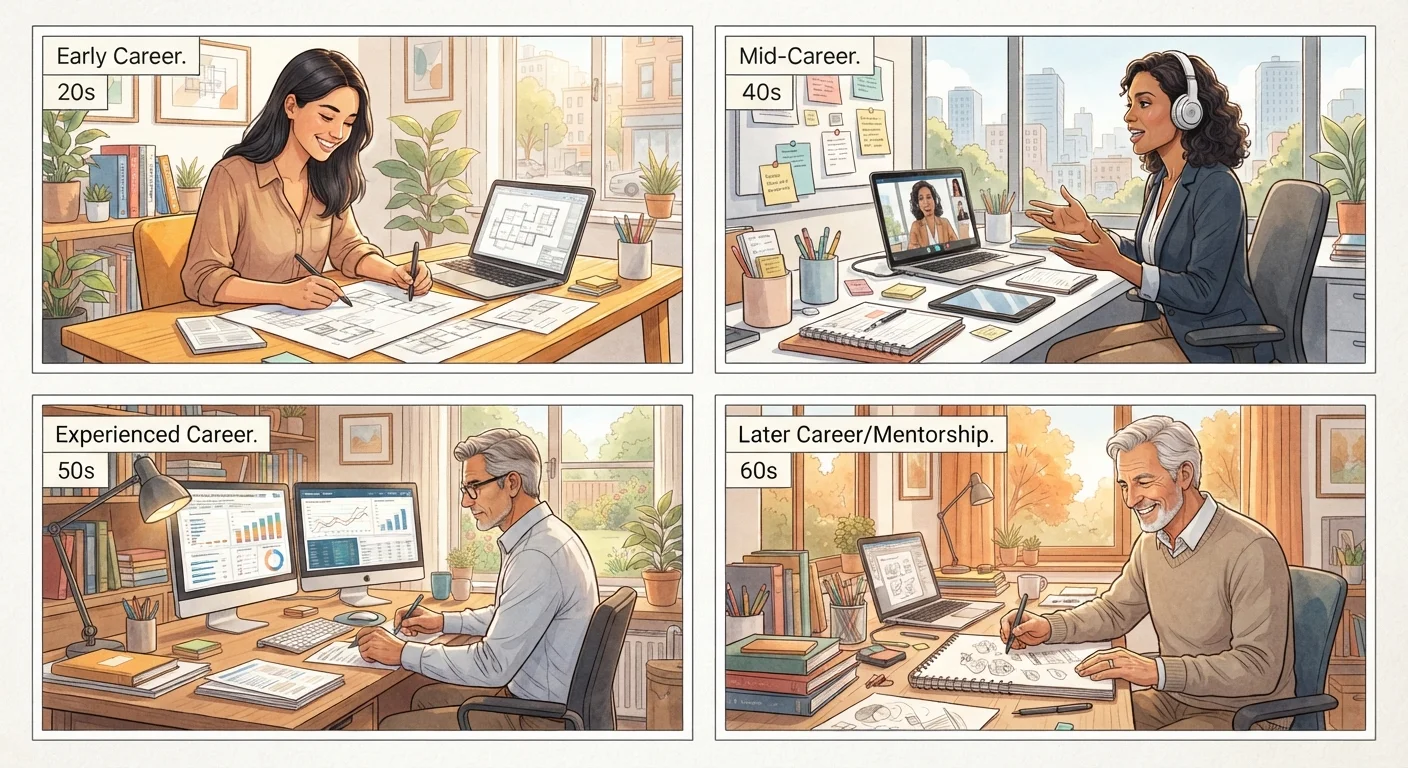
Career planning isn't a one-time exercise you complete at 22 and revisit at retirement. The questions that matter, the risks worth taking, and the trade-offs you're willing to make all shift as your life changes. A 28-year-old building marketable skills operates in a fundamentally different context than a 45-year-old weighing a field change or a 55-year-old thinking about the final stretch before retirement.
What follows is a practical, stage-by-stage breakdown of what tends to matter most - and what's worth your attention - at each phase. If you're just getting started with any deliberate thinking about your professional future, this beginner's guide to career planning is a useful first read.
| Median job tenure (U.S. workers) | ~4 years (U.S. Bureau of Labor Statistics, Employee Tenure Survey) |
| Average number of jobs held by age 54 | ~12 jobs (BLS National Longitudinal Survey of Youth) |
| Workers who changed occupations in a given year | Roughly 5-10% (BLS occupational mobility data, recent years) |
| Most common age range for career pivots | 35-44 (Generally cited in labor mobility research) |
| Career planning benefit | Greater job satisfaction and earnings alignment (Broadly supported by career development research) |
Your 20s: Exploration and Foundation-Building
The primary goal in your 20s is gathering information about yourself - what you're good at, what you can tolerate, and what actually energizes you. This is the stage to try things, make cheaper mistakes, and resist the pressure to optimize too early.
- Explore broadly. Moving across roles or even industries in your 20s carries less cost than later. Diverse early experience often translates into stronger long-term adaptability.
- Build transferable skills. Communication, project management, data interpretation, and problem-solving hold value across almost every field. Prioritize developing these over chasing prestige.
- Invest in your network early. The colleagues, mentors, and professional contacts you build now often become your most valuable career assets later.
- Start saving, even modestly. Financial runway - having some savings - gives you career flexibility. If you're juggling student debt, strategies for saving while managing debt can help you find balance.
Understanding the difference between setting goals and building an actual plan is a useful foundation at this stage. Here's how career goals and career plans work together.
Your 30s: Direction and Deliberate Growth
By your 30s, most people have enough real-world experience to make more deliberate choices. This is the phase for consolidation - deepening expertise, pursuing leadership opportunities, and getting intentional about the trajectory you actually want.
- Clarify your direction. Vague career goals become costly now. Setting specific, useful career milestones keeps your path trackable and adjustable.
- Evaluate fit honestly. If your current field isn't working, your 30s are still a reasonable time to redirect. Research on mid-career transitions suggests outcomes vary widely depending on preparation and planning. Use this checklist before making any major career change.
- Build your reputation in a defined area. Being known for something specific - a skill, a domain, a style of working - tends to accelerate advancement more than being broadly competent.
Life Events Affect Career Planning Too
Marriage, children, caregiving responsibilities, health changes, and geographic moves all affect the realistic shape of a career plan. None of these are detours - they're context. The most durable career plans account for life, not just professional ambitions. Build in flexibility, and revisit your plan when major circumstances change.
Your 40s and Beyond: Leverage, Longevity, and Meaning
Career planning in your 40s, 50s, and beyond is less about building and more about leveraging. You likely have deep expertise, a real network, and a clearer sense of what kind of work you find meaningful. The planning questions shift accordingly.
- Consider whether your current path still fits. Some people double down on their specialty; others pivot. Research on mid-life field changes is instructive here - transitions are more common and more viable than many assume, but they require honest preparation.
- Weigh staying versus starting fresh carefully. Both paths carry real trade-offs. This analysis of staying versus switching lays out the key considerations.
- Think about longevity. Career planning in your 50s should factor in realistic timelines, retirement readiness, and what you want the last working chapter to look like. Consult a licensed financial professional for guidance specific to your situation.
- Leverage your experience as a resource. Mentoring, consulting, and leadership roles often become more accessible - and more satisfying - at this stage.
For a comprehensive framework covering every stage, this end-to-end career planning guide walks through self-assessment, goal-setting, and long-term planning in depth.