

Key Takeaways
Our Verdict
Neither solo nor group travel is objectively superior - the right choice depends on your destination, timeline, and social preferences. Solo planning rewards self-starters who value spontaneity; group planning rewards those who invest in upfront coordination. The critical difference lies in where you direct your energy: solo planners optimize for personal freedom, while group planners optimize for collective buy-in.
| Best for | Recommended |
|---|---|
| Travelers who want full schedule control and spontaneous pivots | Solo travel planning |
| Friends or family seeking shared experiences and split costs | Group trip planning |
| First-time independent travelers building confidence | Solo travel planning |
| Milestone celebrations requiring coordinated participation | Group trip planning |
The Core Distinction: Who Are You Planning For?
The most fundamental difference between solo and group travel planning isn't logistics - it's audience. When you plan solo, every decision runs through a single filter: what do I want? When you plan for a group, every decision runs through a consensus process that can stretch days or weeks.
That distinction ripples through every stage of preparation. Solo travelers can book a flight on impulse, change hotels mid-trip, or skip a museum without debate. Group travelers must weigh those same choices against differing budgets, energy levels, dietary needs, and comfort zones. Neither experience is better, but treating them as interchangeable is where most planning headaches begin.
If you're newer to organizing your own travel, this end-to-end trip planning walkthrough covers the universal building blocks that apply to both approaches before the paths diverge.
Decision-Making Speed and Flexibility
Solo planning moves at the speed of one brain. You can research a destination, price out transportation, and lock in accommodations in an afternoon. That agility is one of solo travel's defining advantages - and it's worth protecting deliberately in your itinerary design.
Group planning introduces what coordination researchers sometimes call social overhead: the time and energy spent aligning people rather than making progress. The larger the group, the more pronounced this effect. A trip for two might take a few calls to organize; a trip for eight can easily consume weeks of back-and-forth before a single booking is confirmed.
| Solo Travel Planning | Group Trip Planning | |
|---|---|---|
| Decision speed | Immediate - one person decides | Slower - consensus or delegation required |
| Flexibility mid-trip | High - pivot anytime | Low - changes affect everyone |
| Budget control | Full control, no splitting | Shared costs, but needs tracking |
| Itinerary structure needed | Can be loose and priority-based | Needs firm anchors and buffers |
| Coordination overhead | Minimal | Significant - scales with group size |
| Accountability | Self-managed | Shared or delegated to lead planner |
One practical countermeasure for groups: designate a lead planner with authority to make final calls after input is gathered. This prevents the endless loop of "whatever everyone else wants" that stalls group decisions. For solo travelers, the equivalent discipline is setting a personal planning deadline - decision fatigue is real even when you're only managing yourself.
Fixed vs. flexible itinerary structures deserve different weight depending on group size: solo travelers can lean flexible; groups generally benefit from more fixed anchors to keep everyone oriented.
Budget Dynamics: Splitting vs. Sole Responsibility
Money is where solo and group planning diverge most visibly. Solo travelers bear every cost alone - accommodation, transportation, meals, and activities land entirely on one budget. That can be a significant constraint, but it also means total transparency: you know exactly what you're spending and why.
Group travel opens up cost-splitting across shared expenses like rental cars, vacation rentals, and attraction tickets, which can meaningfully reduce per-person costs. But those savings come with a coordination tax. Tracking who owes what, managing different comfort levels around splurging, and navigating one traveler's tighter budget without creating awkwardness all require active management.
Use a Shared Expense Tracker from Day One
For group trips, agree on a cost-tracking method before the first booking is made - not after the first disagreement. Simple shared spreadsheets or expense-splitting apps reduce friction dramatically. Establish upfront what counts as a shared expense versus a personal one, and revisit the running total at the end of each day rather than letting it accumulate into a reckoning at the airport.
Solo travelers interested in stretching their dollar further will find useful grounding in how solo travel budget math actually shifts compared to traveling with others. For broader saving strategies that apply before and after a trip, general saving and debt guidance can help with the financial foundation.
Itinerary Structure: One Schedule vs. Many Needs
A well-built itinerary looks different depending on whether one person or ten will be following it. Solo itineraries can be intentionally loose - a list of priorities rather than a strict schedule allows you to follow energy and weather without consequence. Understanding what makes an itinerary actually work is worth reviewing before you build either type.
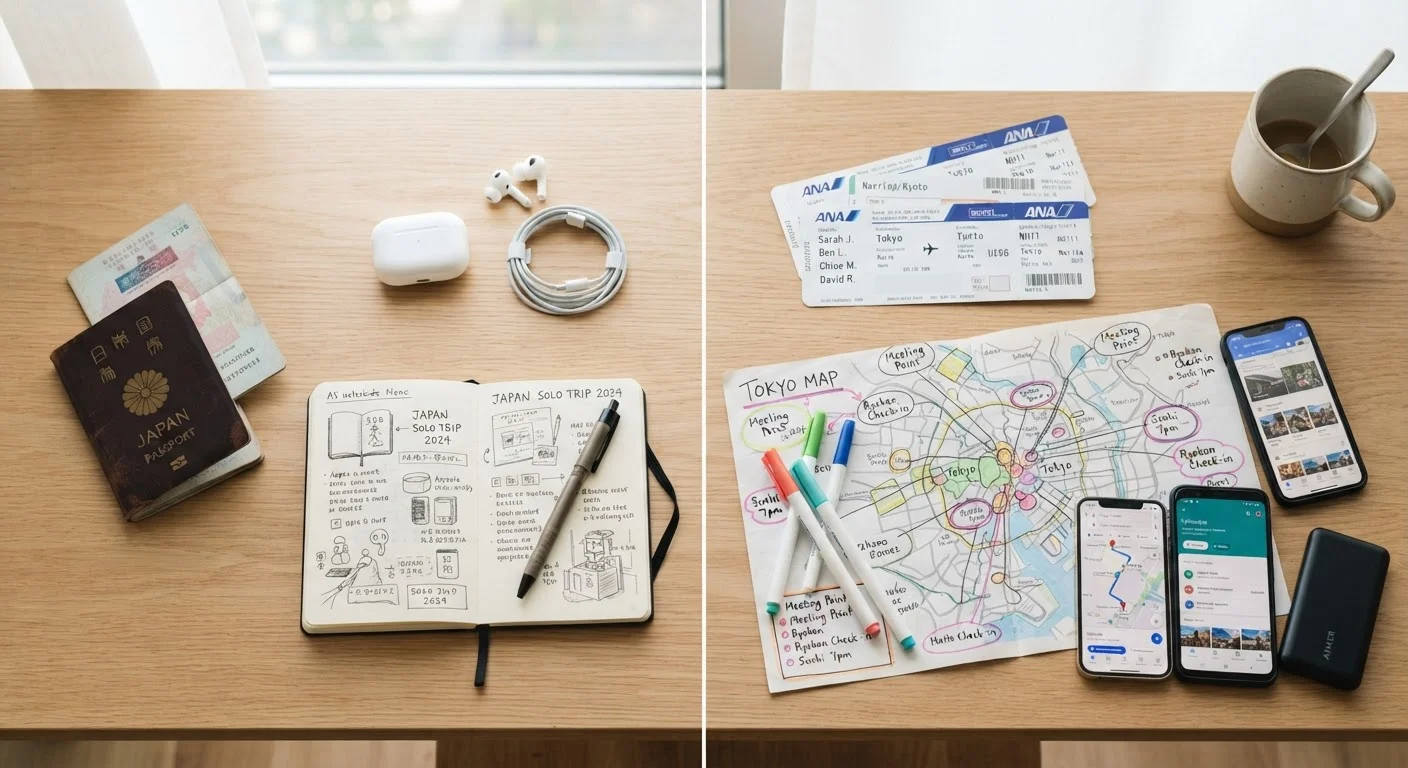
Group itineraries generally need more scaffolding: confirmed meeting points, realistic buffer time between activities, and explicit agreements about what's communal versus what's independent. Building in designated free periods - where travelers split off by interest - can relieve group pressure while preserving the shared experience everyone came for.
3-5x
Longer to coordinate as group size grows
Travel industry research broadly finds that planning time multiplies significantly as traveler count increases beyond two or three people.
60%+
Solo travelers who cite flexibility as top benefit
Surveys of solo travelers consistently rank schedule freedom as the primary reason they prefer traveling alone over group arrangements.
Pace management is another group-specific consideration. One traveler's leisurely morning is another's restless frustration. Establishing a rough daily rhythm (early risers vs. late starters, packed days vs. relaxed exploration) before departure prevents resentment from building on day three. Solo travelers rarely need to negotiate this - but they do benefit from being honest with themselves about sustainable pace rather than over-scheduling.