

Key Takeaways
Minimum Payment Trap
A minimum payment is the smallest amount a credit card issuer requires you to pay each month to keep your account in good standing. Paying only this amount keeps you technically current on your debt, but the bulk of your balance continues to accrue interest - meaning you can end up paying back two or three times the original amount over many years.
Credit card issuers typically calculate minimum payments as either a flat dollar amount (often $25-$35) or a small percentage of the outstanding balance (commonly 1-3%), whichever is greater. Because this percentage shrinks as your balance shrinks, the payoff timeline extends dramatically.
The Math That Card Issuers Don't Advertise
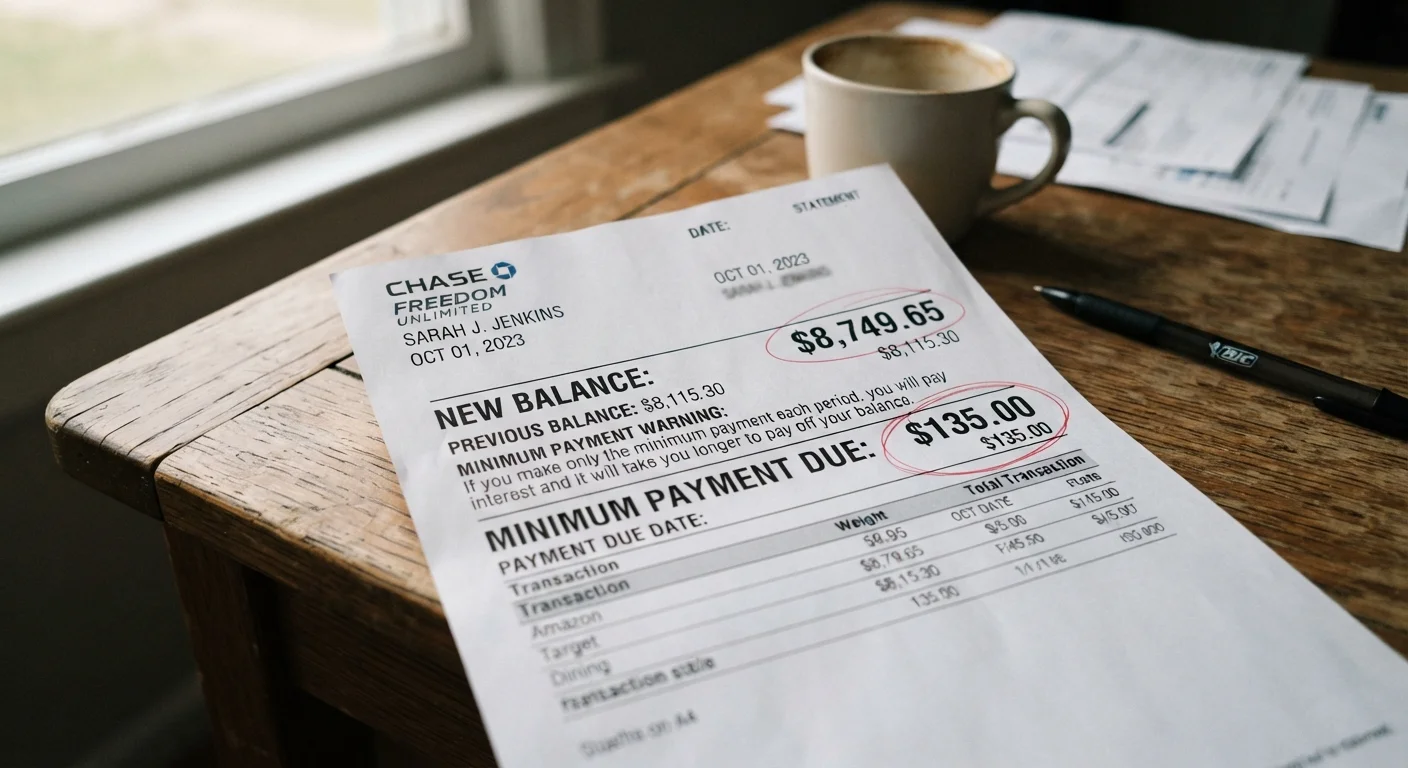
Credit card statements in the U.S. are required by law to disclose a "minimum payment warning" showing how long it will take to pay off your balance if you only pay the minimum. Most people glance past it. They shouldn't.
Consider a $3,000 balance on a card with a 20% annual percentage rate (APR) - close to the national average for cards that carry a balance. If the minimum is set at 2% of the outstanding balance (roughly $60 in month one), and you never add new charges, paying only that amount will take approximately 22 years to fully repay. You'll pay close to $4,800 in interest alone - more than 1.5 times the original balance.
22+ years
Time to repay $3,000 at minimums only
Based on a 20% APR card with a 2% minimum payment - a scenario commonly illustrated in consumer financial education resources.
~$4,800
Interest paid on a $3,000 balance at minimums
Paying only the sliding minimum on a 20% APR card turns a $3,000 balance into roughly $7,800 in total repayment over the life of the debt.
20%+
Average APR for cards carrying a balance
The Federal Reserve has tracked average credit card interest rates consistently above 20% APR for accounts assessed interest in recent reporting periods.
The reason is compound interest. Each month, interest is calculated on your remaining balance. Because minimum payments are calibrated to barely exceed the interest charge, very little of what you pay actually reduces your principal. The key terms behind this math - APR, principal, and amortization - are worth understanding before you map out any repayment strategy.
Why Minimum Payments Are Structured This Way
Minimum payments aren't designed with your financial freedom in mind. They are designed to keep your account in good standing - from the issuer's perspective. A customer who pays minimums indefinitely generates far more interest revenue than one who pays off their balance quickly.
Before 2003, many issuers set minimums as low as 2% of the balance, which meant the payment often barely covered interest charges. Regulatory pressure led to modest increases, but the structure remains favorable to lenders. The sliding-scale minimum - which shrinks as your balance shrinks - is particularly powerful at extending your debt horizon because you naturally feel like progress is being made as the required payment drops each month.
Minimum Payments and Credit Score Are Separate Issues
Paying the minimum on time does protect you from a missed-payment mark on your credit report, which is the most damaging credit event possible. However, a high outstanding balance relative to your credit limit - called your credit utilization ratio - can still drag your score down even when you pay on time every month. Reducing your actual balance is what improves both your financial position and your credit profile.
This is connected to a broader pattern of habits that quietly undermine debt payoff progress: actions that feel responsible in the moment but slow your actual progress toward being debt-free.
Breaking the Cycle: Practical Steps
The single most effective adjustment most people can make is to freeze their payment amount. Instead of letting the minimum shrink each month as your balance declines, commit to paying the same fixed dollar amount you were charged in the first month - and maintain it throughout repayment.
Fix Your Payment Amount Early
When you first receive your statement, note the minimum payment amount and commit to paying at least that fixed dollar figure every single month - even as your balance (and the calculated minimum) decreases. This one change can shave years off your repayment timeline and save hundreds of dollars in interest without requiring a large immediate sacrifice.
On a $3,000 balance at 20% APR, fixing your payment at $100 per month instead of following the sliding minimum cuts the repayment period from over two decades to about 3.5 years, and reduces total interest from roughly $4,800 to under $1,200. The math shifts dramatically with even modest increases.
Additional strategies worth considering:
- Pay biweekly instead of monthly. Making half your payment every two weeks results in one extra full payment per year, reducing principal faster.
- Apply windfalls directly to principal. Tax refunds, bonuses, or gift money applied to your balance create outsized reductions in total interest owed.
- Prioritize highest-rate balances first. If you carry multiple cards, directing extra payments toward the card with the highest APR (the avalanche method) minimizes total interest paid across all accounts.
If you're also trying to build savings while managing this debt, the balancing act is real but achievable. See our guide on building an emergency fund while carrying debt for a framework that addresses both goals simultaneously. And if you're unsure whether to prioritize debt repayment or savings at all, how to decide what comes first breaks down the decision by interest rate and risk tolerance.
This article is for general informational and educational purposes only and does not constitute personalized financial advice. For guidance tailored to your situation, consult a qualified financial professional.