

Key Takeaways
Option A
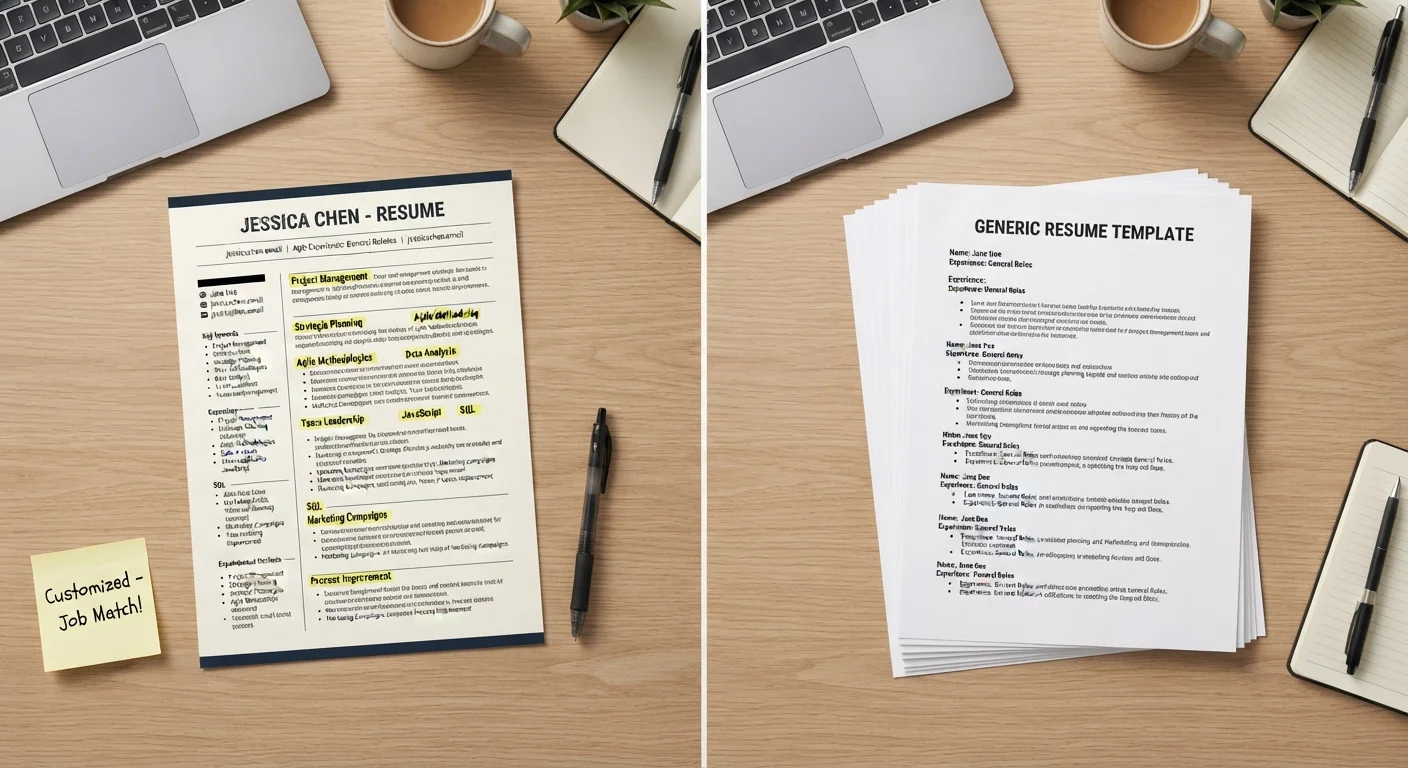
Tailored Resume
The targeted, high-effort approach built for specific roles.
Best for: Job seekers applying selectively to roles that closely match their background, especially in competitive fields.
Option B
General Resume
The broad, efficient approach designed for volume applications.
Best for: Job seekers exploring options across industries or needing to cast a wide net quickly.
If you're applying to 3-5 carefully chosen roles per week
Tailored Resume
With a manageable application volume, you have time to align keywords and reframe accomplishments for each posting - and the payoff in callback rates tends to justify the effort.
If you need to apply broadly and quickly due to urgent job loss
General Resume
A polished general resume gets you moving fast. Pair it with targeted cover letters and follow up on your strongest matches for better results.
If the job posting uses very specific technical or skills-based language
Tailored Resume
ATS filters frequently screen for exact keyword matches. A general resume risks being filtered out before a human ever sees it.
If you're exploring different industries or roles simultaneously
General Resume
A well-structured general resume gives you flexibility to pursue multiple directions without spending hours rewriting for each one.
What the Research Actually Shows
The debate between tailoring and sending a general resume isn't just a matter of preference - it has measurable consequences. Studies of applicant tracking systems (ATS), the software most mid-to-large employers use to sort incoming resumes, consistently find that keyword alignment between a resume and a job description is a primary factor in whether a resume clears the initial screening. Research from careers analytics firms has found that a significant share of resumes are rejected by ATS before a recruiter ever reviews them - with some estimates placing this figure above 70% for high-volume employers.
That said, the research also tells a more nuanced story. Tailoring is not a guaranteed shortcut to interviews. A poorly written resume customized to a job description still underperforms a clear, well-organized general resume. The quality of the document's content and structure matters alongside its keyword matching. Understanding how today's hiring landscape works - including where ATS filters actually sit in the process - helps you decide where to focus your energy.
| Criterion | Tailored Resume | General Resume |
|---|---|---|
| ATS keyword match | High - aligned to job posting | Variable - may miss key terms |
| Time per application | 30-60 minutes | 5-10 minutes |
| Callback rate (selective applying) | Generally higher | Generally lower |
| Scalability at volume | Difficult above 10-15/week | Handles high volume easily |
| Recruiter readability | Role-specific and focused | Broad; may seem unfocused |
| Best entry point | When role closely matches background | When exploring options widely |
The Real Cost of Going General
Sending the same resume to every posting is fast, but the trade-off shows up in your response rate. When a resume isn't calibrated to the specific language of a job description, it may use synonyms that ATS doesn't recognize, omit skills the employer explicitly listed as requirements, or lead with a summary that doesn't speak to the role at hand. The result is a document that looks fine on paper but fails the automated filter - or reads as generic to a recruiter who reviews dozens of applications daily.
If you've been applying to dozens of jobs and hearing nothing back, a mismatch between your resume and the posting's language is one of the most common culprits. A general resume also tends to bury the lede: your most relevant accomplishments for a particular role may be present but not prominent, making it harder for a reviewer to quickly see why you're a fit.
75%+
Resumes filtered by ATS before human review
Industry estimates suggest the majority of resumes at large employers are screened out by ATS software before a recruiter sees them.
2x
Callback rate increase with keyword alignment
Research from career platform studies suggests resumes closely mirroring a job description's language can roughly double interview request rates.
The Real Cost of Tailoring Everything
Tailoring sounds like the obvious answer - but it comes with a real time cost that job seekers often underestimate. A meaningful customization goes beyond swapping a job title in your summary. It involves reviewing the posting carefully, identifying the skills and experience the employer emphasizes, reordering or rewriting bullet points to surface relevant accomplishments, and adjusting your professional summary to speak directly to the role.
Done properly, this can take 30-60 minutes per application. If you're applying to 20 or 30 positions a week, that math becomes unsustainable quickly. The risk is that exhaustion leads to lower-quality customizations that provide little benefit over a strong general resume. Before you hit send on any application, consider running through a structured review - a pre-application checklist can help you catch gaps without starting from scratch every time.
Tailoring Doesn't Mean Overstating Your Experience
Adjusting your resume language to reflect a job description's terminology is legitimate and encouraged. However, there's a meaningful line between emphasizing relevant skills accurately and misrepresenting your experience to fit a role. Recruiters and hiring managers verify claims during interviews, and overstating your background tends to surface quickly. Focus on surfacing genuine accomplishments in the language the employer uses - not on inflating what you've done.
A Practical Hybrid Approach Most Job Seekers Miss
The most effective strategy for most people isn't strictly one approach or the other - it's a hybrid. Start by building a comprehensive master resume that includes your full work history, a range of accomplishments with quantified results where possible, and all relevant skills. This document is never submitted as-is; it's your source material.
From the master, maintain two or three role-specific versions targeting your primary job categories. When a specific posting comes along, those versions need only light adjustments - keyword swaps, reordering a few bullets - rather than a full rewrite. This approach also aligns well with common advice on cover letters: a cover letter that doesn't sound like everyone else's can complement a well-tailored resume and signal genuine interest to a hiring manager. It's also worth examining which widely held assumptions about resume strategy are actually supported by evidence versus career folklore - common job search myths can quietly derail a search.